Daitoshokan no Hitsujikai: Poor Specs, Decent Feel
First off, I’m not talking about the game — I already covered that here. This time it’s the anime.
Looking at recent years, visual novel adaptations are pretty much drowning in the flood of light novel and manga adaptations when it comes to late-night anime. Not sure if it’s because most eroge studios don’t have much money, or because eroge sell on the 18+ content rather than the story alone, or maybe… making a good VN adaptation is just that hard.
You can count the VN adaptations that really succeeded on one hand. Most of them end up wrapping up half-assedly, the audience watches casually, and by next season it’s forgotten. It’s not that studios can’t do it — it’s that VN adaptations are brutally hard on a limited budget. Anyone who’s played a visual novel knows the big difference from light novels and manga: branch routes into parallel worlds. And in one heroine’s route, the others basically don’t exist. Every VN has several heroines, each with her own fans, so which route to take and how to arrange them becomes a nightmare. Some games even have routes that conflict with each other. Just weaving every heroine’s story into something coherent is hard enough; making that blended mess logical on top of it is damn near impossible. Story is only part of a game or anime, sure, but it’s the core — no amount of pretty production saves a garbage script, and that’s exactly the wall VN adaptations hit right now.
So to dodge the shipping wars, the writers go all out and stretch the common route in the anime longer, longer, and longer. You don’t find out who the protagonist ends up with until the final episode, even though in the game they’ve already been banging like rabbits. Some just say screw it and pull time-travel shenanigans, writing multiple world lines so the protagonist gets a turn with every heroine. Oh, and right — VN adaptations can’t actually show the deed. Ecchi teasing is the absolute limit. A nukige without the H is like a man without his dick: zero combat power. So season after season, VN adaptations drop dead at the finish line, staring up at all the tea-drinking moe shows ahead of them.
So… when we heard Daitoshokan no Hitsujikai was getting an anime, a lot of people were wondering how it was going to die.
After the announcement, a full year of silence. Normally a VN gets adapted to promote a sequel or a fandisc, but Daitoshokan’s fandisc Dreaming Sheep was already out, and the anime only limped in this October.
I have no idea what the investors were thinking. I genuinely can’t figure out what this show was supposed to promote…
Or maybe… the team just wanted to make a good anime?
Making a VN anime to sell copies instead of as a promo? What a joke. Only a certain TYPE-MOON would dare pull that. Soon after, character designs and a promo video dropped. Everyone’s face turned into a Mudkip.
Faithfully reproducing AUGUST’s apple faces at high quality was never happening — everyone saw that coming. Whatever the team put out was going to get trashed, and on top of that, what they put out genuinely wasn’t good.
“I’m not sure this anime will satisfy viewers and fans of the game… but we’ll do our best to make everyone happy.” In the pre-air promo PV, the director said this with his head down, zero confidence. The team really didn’t believe in themselves — they even brought in the game’s original artist for the BD cover, not brave enough to use anime footage.
So I went in with low expectations. But watching episode by episode… it was actually pretty good.
The original game is a heavy slice-of-life comedy with plenty of exaggerated reaction faces, and the team seemed to know they had no budget for animation or for replicating the August faces, so they doubled down on reaction faces and over-the-top motion. Risky bet: do it well and people chuckle, do it badly and you’re branded a trainwreck. But it actually works. At least I found it acceptable, even kind of fresh.
Route-wise, it follows the standard VN adaptation playbook: stretch the common route as long as possible, don’t let the protagonist commit too early. The game’s main plot splits into the Minazuki Festival and the Shepherd arcs, and Kotachi’s big moments come in the Shepherd part after the festival. A 12-episode anime obviously can’t cover all of that, so the team folded the Shepherd exam plot into the pre-festival part and ended the show with the festival. Nothing wrong with that.
Worth noting: Kotachi’s personality diverges a lot from the game. In the game she’s just a slightly devilish soft girl, not the deranged menace she is in the anime. Same for the vice president — she’s just a yuri girl in the game, and the anime overdoes her pettiness to make a point.
About the “Shepherd” identity: the game gives a fun explanation — the ones who are kind to everyone and never get too close to any one person are best suited to be a Shepherd. Kind of a jab at harem protagonists across ACG. If the protagonist doesn’t pick a partner at the end, he can only become a Shepherd, and obviously that ending won’t do. The team made an interesting call: make him a Shepherd first, then strip him of the job when his identity gets exposed. Contrived, but in the game, picking any one heroine as the true main one doesn’t quite work either. Suzuki Kana is the most popular, so her plot can’t be cut. Kotachi is the True End heroine and the Shepherd mainline, so she can’t be cut. Shirasaki is the game’s official pairing and the library club president, can’t be ignored. Chieri ties into the railgun host and the festival’s success, can’t be cut either. So poor Tamamo, our egg princess, gets the shaft — her bundled foreshadowing about the best friend’s true identity gets brutally chopped as optional. In the game Tamamo actually matters a lot, since the library club can’t function without her scheduling, and cutting her makes the club feel like a joke. But VN adaptations always have runtime limits, and the team surely knew that. This was the only call left.
While I was enjoying the show, I kept hearing complaints — about the story, the visuals, all the production factors. Mostly “it’s falling apart,” some about routes.
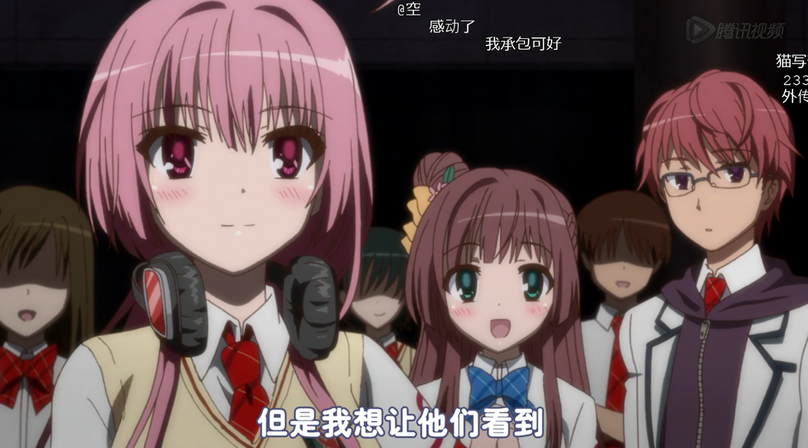
Honestly, the Daitoshokan anime is made on a budget. Most backgrounds are crude color blocks, plenty of people have no face, and if you pause, faces fall apart, Kotachi’s black tights appear and vanish, Chieri’s tights are glossy one moment and matte the next. The BGM is lifted wholesale from the game yet has no presence. Production-wise, it’s not what you’d call polished.
As for route choices — I said it earlier, there was no other option. Counting side characters, there are eight romanceable heroines, fandisc not included. Covering everyone is impossible, and the ending is open enough to at least give you something to hold onto. As a Kotachi fan I’m satisfied. What more do you want…
I don’t know if smartphone reviews did this to me, but somewhere along the way we stopped just enjoying anime and judging it by how it felt. Now we like to dissect the thing, inspect every part, check whether each component is premium. Is the animation director famous? Does the director have a shady past? Is the soundtrack fire? Is the cast stacked? If even one box isn’t checked, apparently the whole thing must be shit.
It’s not that absolute. Say you’re eating century egg and pork congee — do you really fish out every ingredient and taste it separately before judging? Or a bowl of instant noodles: while you’re enjoying the sour kick, do you stop to think the ingredients aren’t exactly top-grade?
In audiophile circles there’s a fun word for evaluating headphones: “feel.”
Sometimes a headphone gets a great review: “Bad specs, good feel.”
Meaning the measurements aren’t impressive, but mixed together it sounds okay.
So for the Daitoshokan no Hitsujikai anime, my verdict is: bad specs, good feel.
I’ve rambled enough. You get what I mean, right?
Comments are hosted on the Chinese main site. This mirror is read-only.