Natsuiro Ramune (夏色ラムネ) Review
Sometimes I stop and wonder how long it’s been since I last played a landmine game.
Maybe I’ve just gotten more sensitive lately. One look at a game’s setup and I can tell if it’s shit, so I haven’t stepped on one since the second half of last year…
But there’s one thing I can’t resist: the art style. If the art hits my tastes just right, I’ll overlook the landmine parts and be willing to forgive a whole lot more.
And it’s not just me. According to a poll I ran on some dumbass social media site, over half the people said “a work with good-looking characters but a boring story” beats “a work with a great story but characters you can’t stand to look at.” It’s a shallow world, I guess. And I love Sesena Yau’s art that much. Even though one of her previous games was mind-numbingly dull, this time I fired up her new one without hesitation—even though I vaguely remembered seeing someone on Weibo tear it apart with a long screenshot post calling it garbage.
The game is Natsuiro Ramune. And just like I said at the start, it’s a landmine. Sesena Yau drew another landmine.
I’ve always found it amusing how Japanese people love describing things with “XX color”—sakura-iro, natsuiro, koi-iro, haruiro, all that. There’s really no way to translate it; most of the time you just leave it as is. As for the ramune part, that’s the “bottle soda” you always see in Japanese anime—the kind sealed with a glass marble. For most Japanese people, it represents childhood.
Actually, I liked soda as a kid too. My grandma worked at a soda factory, so I drank plenty. But all the soda I drank came in bottles with caps—nowhere near as fancy as the Japanese marble-sealed kind.
Glass bottle soda has become a kind of memory of youth for modern people—specifically, childhood memories. The title Natsuiro Ramune mostly makes you think of summer vacation and childhood.
Yep, that’s exactly what the game is about.
The game starts by describing how the protagonist grew up in a mountain village, always hanging out with his friends at a little shop, buying stuff and playing, leaving behind lots of fond memories.
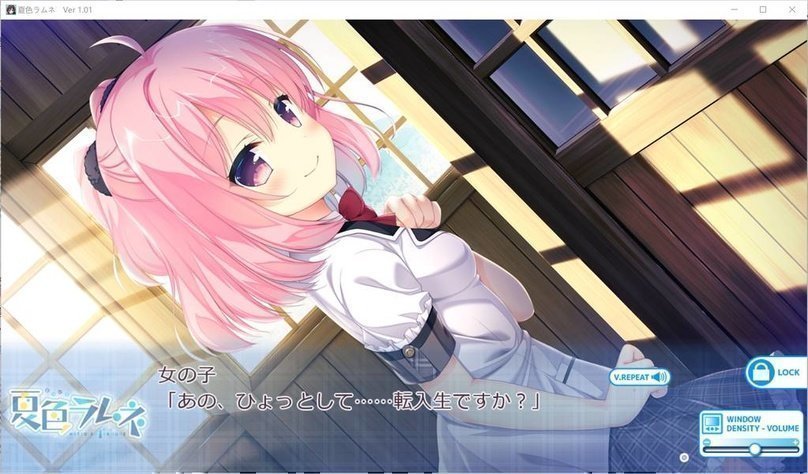
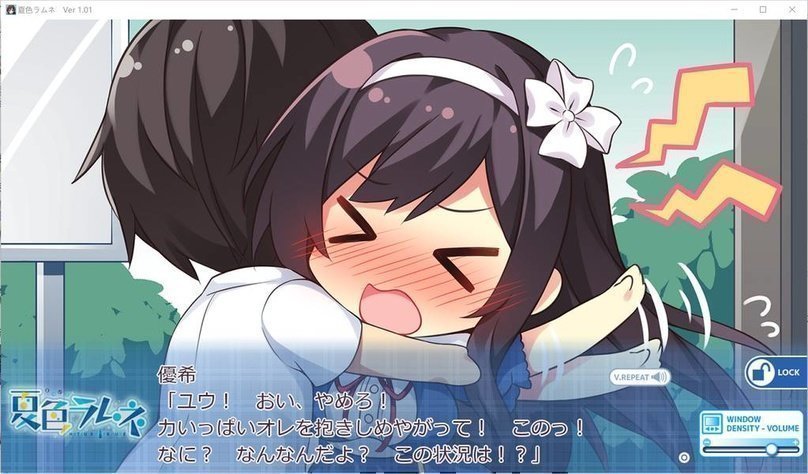
Later, the protagonist moves to the big city. Years pass, and he returns to his hometown to find his childhood friends all grown up, each having changed quite a bit… Some just got bigger boobs. One who looked like a boy as a kid grew into a black-haired gal in black tights with huge breasts. And another turned into a lunatic who constantly claims she can talk to aliens.
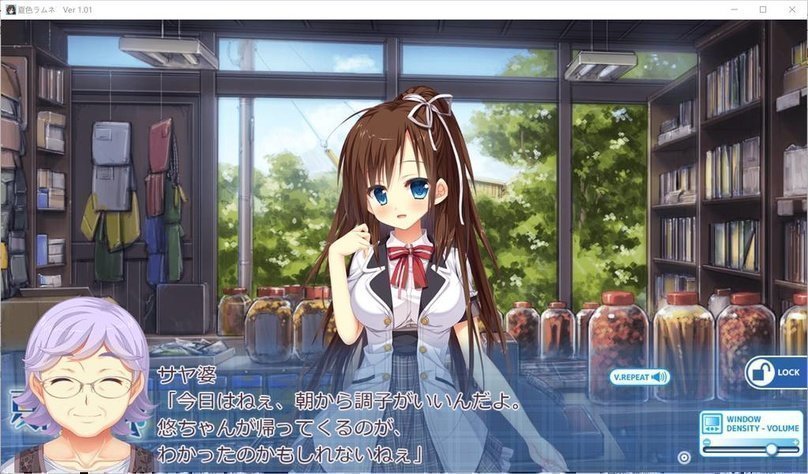
The old friends have all grown up, and the protagonist often finds himself reminiscing. That’s when he remembers the little shop he used to visit as a kid… only to find the old lady who runs it in increasingly poor health, to the point where the shop might close down because of it.
The protagonist and his friends think it over—at this rate the shop is doomed. That won’t do. So they all agree: let’s band together and help the old lady keep the shop going.
“No, no… find someone else. I’m not being modest—you’re all just kids with bright futures ahead of you. You can’t spend your youth running a little shop.”
The old lady refuses at first, but eventually gives in to the protagonist and his friends’ persistent pestering.
That’s basically the main plot: return to your hometown, revitalize the old industrial base… no, wait, revitalize the little shop, protect your childhood memories.
But the game has four heroines you can pursue, and only the first heroine, Sakashita Yasumi’s route, seems to have anything to do with “revitalizing the shop.” The other routes go completely off the rails. How do I know? Because I fucking went off the rails myself.
The game’s choices start right from the beginning. Most of the time you get three options expressing your affection for whoever’s on screen. Roughly translated, the three options mean:
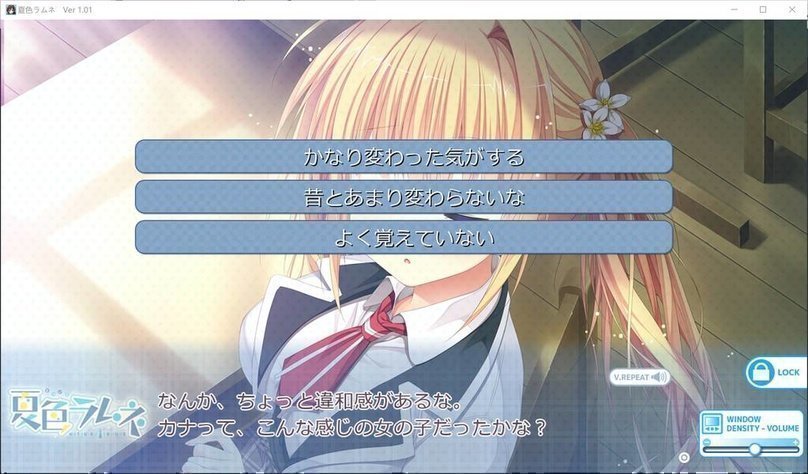
“1. This girl’s not bad, I like her.” “2. She’s whatever.” “3. Get lost, next.”
So you go through this choice set for pretty much every heroine, and then the game decides which route you enter based on your affection points.
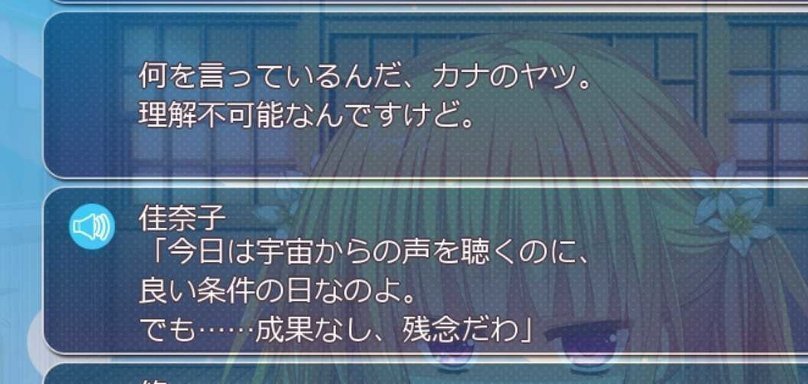
But honestly, I have no idea how the affection calculation works. The blonde girl (Yamazaki Kanako) kept spouting chuuni nonsense, always standing around saying she was receiving signals from aliens in space. I picked every option that mocked her or called her an idiot.
And I still ended up on her route.
Ironic. So ironic.
Once you’re on her route, she doesn’t really confess to the protagonist. They just keep bickering. She just unilaterally turns into a sadist and approaches the protagonist, and sleeps with him first.
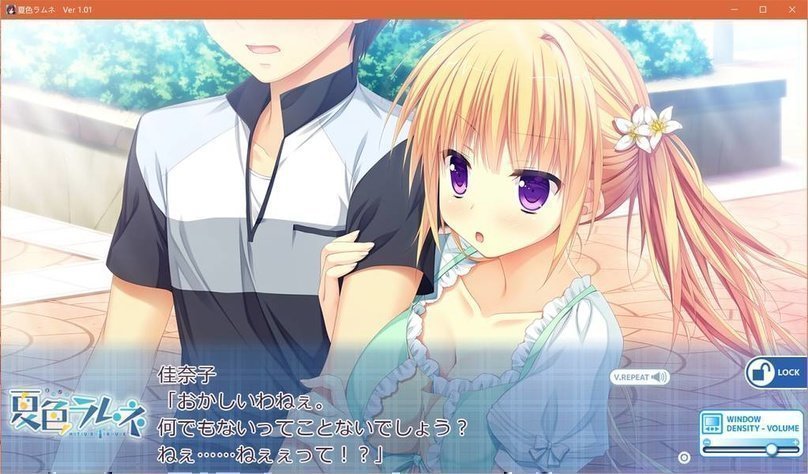
Only after sleeping with him does she propose they start dating. And only then does the protagonist say he likes her.
Thrilling. So thrilling.
There are plenty of games where they get physical before dating, and I could let that slide, but then the game suddenly changes tone… and shoves a mouthful of shit down my throat with the speed of lightning and the momentum of a breaking bamboo.
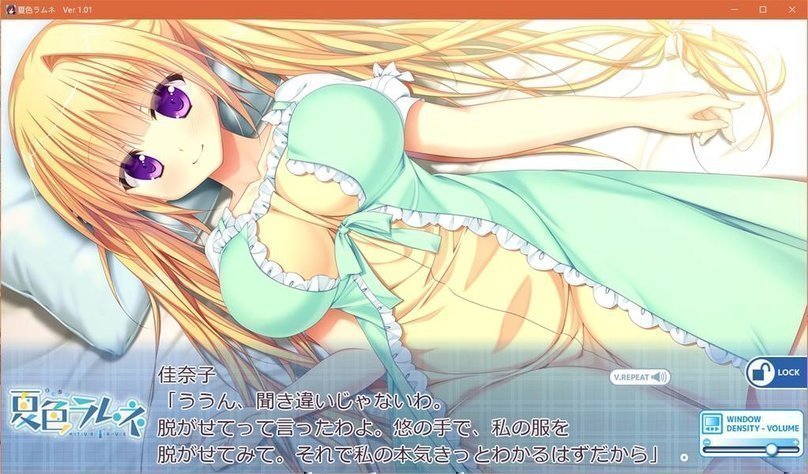
Insane. Absolutely insane.
In the latter half of Kanako’s route, the protagonist finds her praying at a shrine. While praying, Kanako suddenly turns into a little girl, then flickers back. After that, the protagonist notices she seems to have lost her memories—she talks like a child, completely unlike her age, as if her consciousness is stuck in childhood.
A few days later, Kanako seems to return to normal.
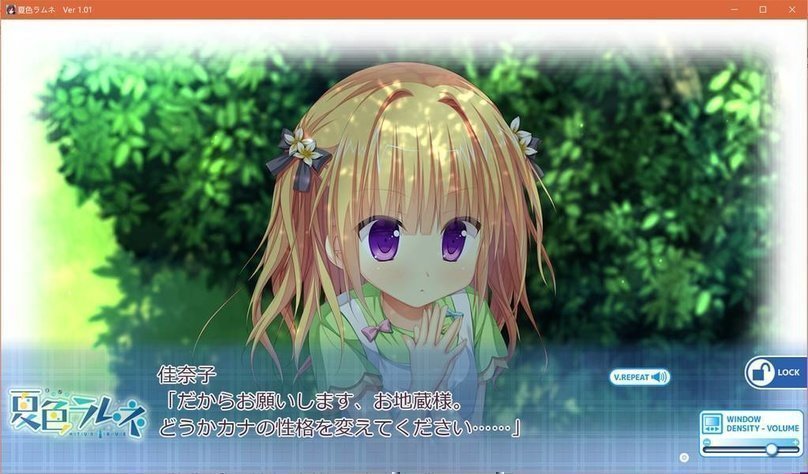
The protagonist is confused and starts investigating, eventually discovering that Kanako seems to have a split personality: one is a timid little girl, the other is bold and direct—the way she was at the start.
Eventually, Kanako tells him the truth.
When Kanako was little, she played with the protagonist and liked him. When he was about to leave the village, she didn’t want him to go, but she was too shy and scared to say so. After he left, she regretted it deeply and went to a lake behind the mountain to make a wish…
She wished to become “a very open, bold, courageous person.” And wouldn’t you know it, there really was a god in that lake, and it granted her wish.
And how did it grant it?
By cloning a second personality from Kanako’s body—one that was “open, cheerful, and brave”—and replacing her original personality with it. The original personality still existed somewhere in her body, just dormant.
With this brand-new “open” personality, Kanako became the grown-up version: very talkative, no longer shy like she was as a kid, and she even actively pursued and landed the protagonist.
But Kanako’s original personality was still curled up somewhere inside her, occasionally surfacing, but only with the cognition of a toddler…
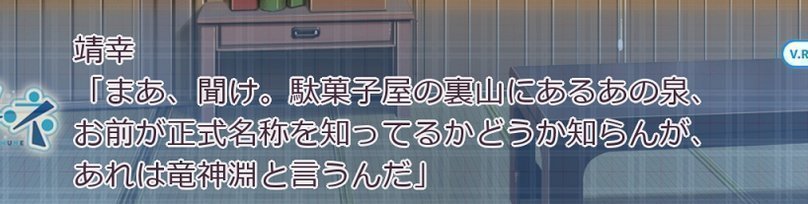
So basically, the god created a “fake Kanako” and stuffed it into her body, letting the fake disguise her originally fragile self. And because this Kanako was created by a god, she naturally picks up messages from the cosmos, which makes her look like a lunatic.
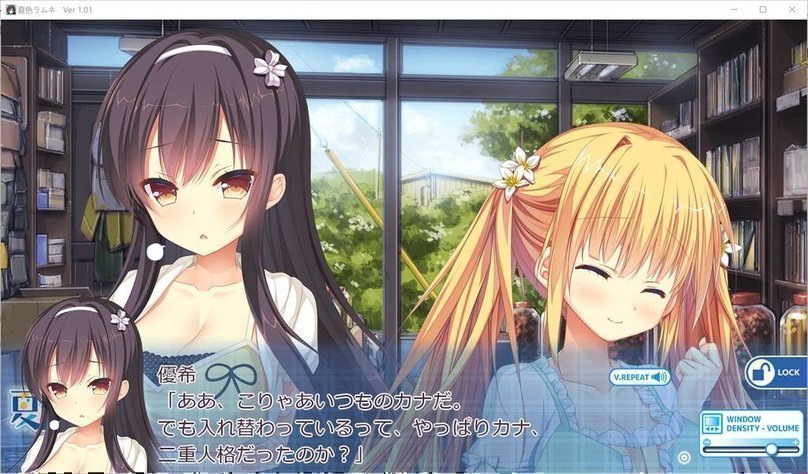
In a normal game, this kind of development would go: the “real Kanako” is called back out, the fake leaves, stops helping her put up a front, and she returns to her true self, with the protagonist staying by her side through it all for a happy ending.
But this game’s genius lies in not following common sense.
The protagonist declares he’ll help Kanako solve her split personality problem, so he goes back to the wish-granting god.
The result of the wish… the childlike Kanako is sacrificed… and the current mature, open Kanako is kept.
In other words, the real one is discarded, and the protagonist chooses the fake.
Shortly after the fake takes over, she suddenly has to disappear too. The reason is clear: “I’m a fake, created based on the real one. The real one is gone, so I’ll disappear too.”
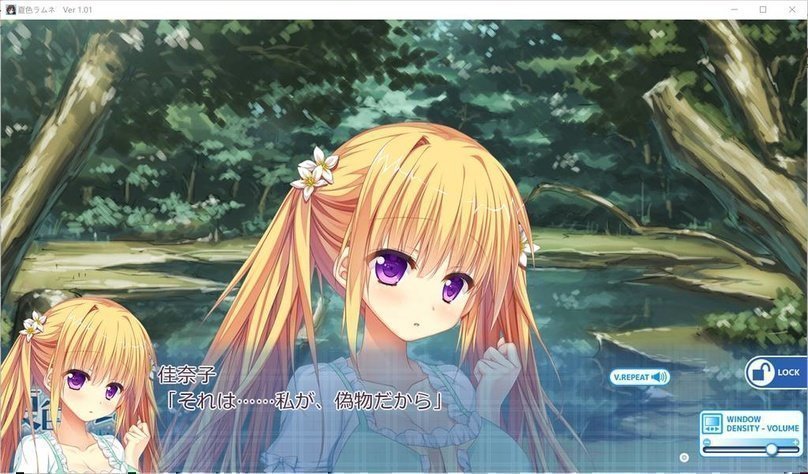
The protagonist refuses to accept this and asks the god how to keep the fake…
The answer is simple: replenish the mana!
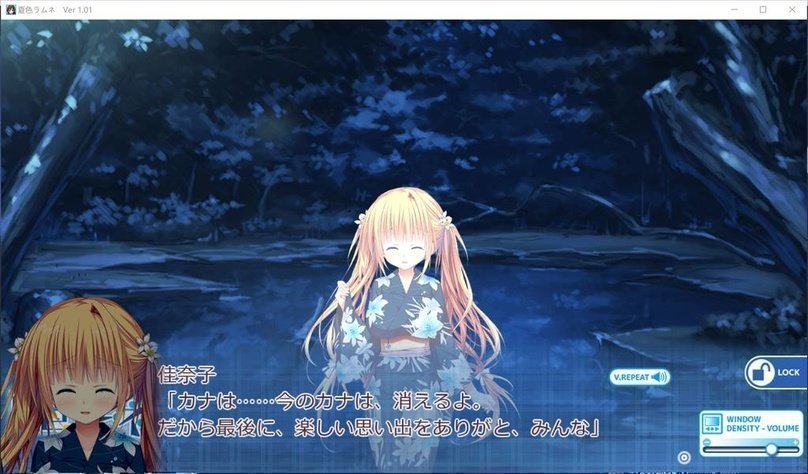
And then the protagonist immediately drops his pants and starts banging this fake blonde. If I remember correctly, he came to see the god together with his friends—so he’s just pulling down his pants and going at it in front of everyone. All I can say is, you are hardcore as fuck, like a bamboo that’s been through hell.
The ending is predictable even with a bamboo’s asshole for a brain: the protagonist and the fake heroine live happily ever after, and everyone blesses them, saying they’re blessing the heroine for “rebuilding herself” and tying the knot with the protagonist…
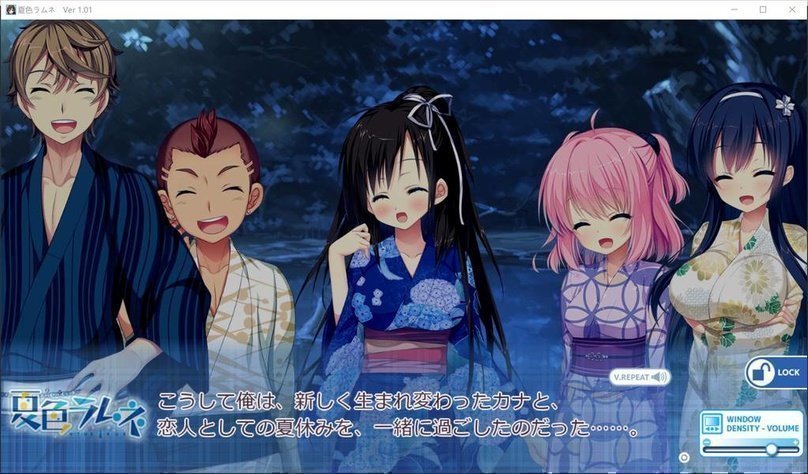
And nobody mentions that the real Kanako—the little girl who loved the protagonist all those years ago and made a wish because she lacked courage—has been sacrificed forever.
Sure, the protagonist found his happiness, but he chose the fake and threw away the real one. I just can’t accept it. I can’t even understand the writer’s logic.
For example, imagine you’re a fat, disgusting otaku from Chongqing who loves cola and black tights. You want a big-titted girl in black tights to sleep with you, but you feel inadequate in every way, so you go to a god and wish to become handsome and not disgusting. The god creates another “handsome, not disgusting” version of you, and you just watch as “the other perfect you” goes after the black-tights girl you like, sleeps with her, and bangs her. That person is “another you,” but he’s still not you.
You still have nothing…
All you get is “another you” NTR-ing “the current you.”… The sex, the girl, the big tits, the black tights—none of it has anything to do with the original you.
So that’s what makes the blonde route in Natsuiro Ramune so disgusting.
But that’s not the only nauseating thing about this game.
First, the game’s system is full of bugs. Touchscreen support being bad is one thing, but if you don’t return to the title screen before quitting, your save files mysteriously disappear. Even if you saw the save complete, restarting the game after closing it loses it… I had to replay large chunks several times because of this.
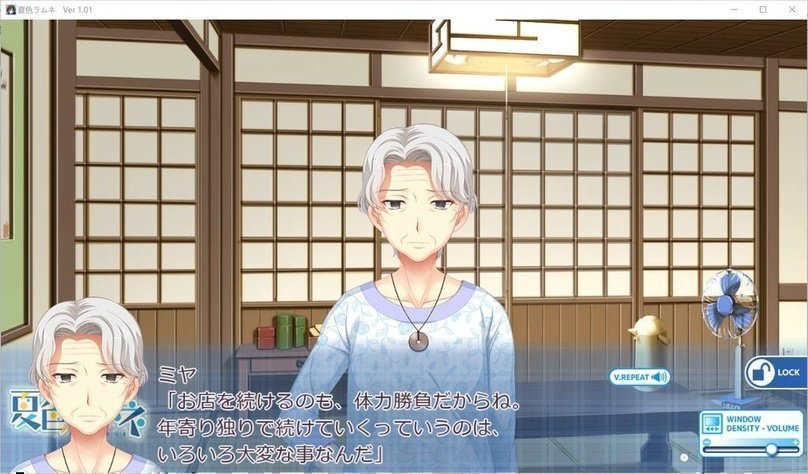
Then there’s the music and direction—really low quality. Abrupt transitions, monotonous tracks; it gets old fast.
And the voice acting isn’t much better. Tachibana Mao sings well and looks fine, but her flat voice hasn’t changed in years. Hanakage Hotaru, a recent newcomer (?), still sounds like Akino Hana when she first debuted—only capable of moe voices. Ayusara’s performance in this role felt completely phoned in, like she just picked up her paycheck and left.
And the worst is Kanako’s VA. I don’t even know her name—probably Mitakarin. I have to say, this person’s voice is explosively awful… She’s voicing a young girl but sounds like a 45-year-old housewife. Maybe the director told her to do two voice types—one for the child and one for the adult (still a high schooler anyway)—and she overshot the adult part so badly it ended up like this.
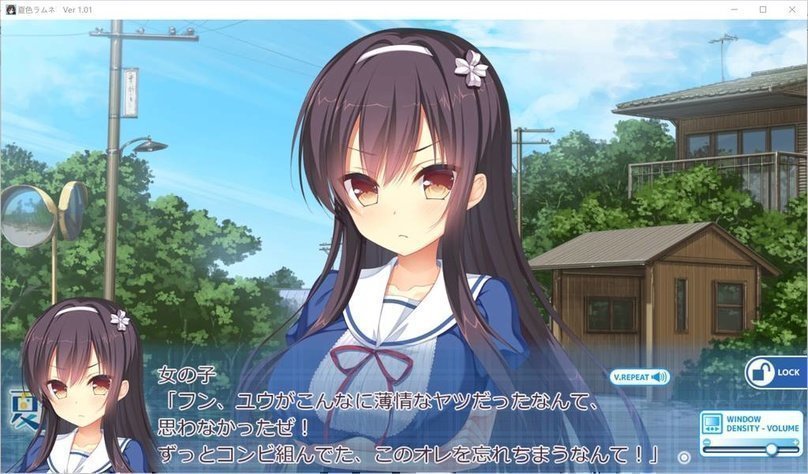
The game’s premise is “childhood friends grow up and work to protect the little shop,” but for most of the game, there’s barely any shop management. Unless you’re on the first heroine’s route, it’s totally unrelated. The boring music, boring dialogue, boring voice acting, and that inexplicable mouthful of shit at the end—after finishing one route I had zero desire to start another. Then I happened to see this…
 “Anyone who actually finishes this whole game is, frankly, out of their goddamn mind.”
Ah, I guess I’m still not strong enough… Anyway, there’s way too much to complain about. Especially that sickly old lady—she doesn’t look sick at all. And running a little shop? How much stamina does that take? You just sit at the counter playing Honor of Kings day after day and it’s over.
That said, the game isn’t without merit. The OP is really good, and the animation’s nice too—but… that’s about it. If you’re hyped for this game, I suggest you just watch the OP and imagine the story in your head.
I don’t want to play the first heroine’s main route. I remember seeing it get trashed on Weibo, and I still have some fondness for her, so let’s just keep that fondness in my heart.
Comments are hosted on the Chinese main site. This mirror is read-only.