Hoshiori Yume Mirai (星織ユメミライ) Review
Hoshi Ori Yume Mirai: The Other Side of the Shadow
The world is dark. But that’s not enough of a reason to deny that light exists.
I know this one guy. Met him online, same as usual. From the moment I met him I thought he was mediocre. Mediocre in the sense that, sure, you can chat with him, but nothing about him stands out. No rebellious streak, never picks a fight, always smiling, doesn’t seem to have much of an opinion of his own. Not that he’s clueless — he knows plenty — but nothing he knows counts as expertise.
Sometimes I figured this guy’s life had zero passion in it. But he always seemed happy.
I asked him once if there was anything he wanted to do. He said he wanted to be a programmer someday. “Like, writing insane software?” He shook his head. “That’d be great if it happens, but just writing stuff that solves people’s problems is fine too.” He paused. “I like writing code. Same way most kids like building with blocks.”
So I stopped keeping in touch. Mostly because talking to him was boring — he’d listen to anything you said, then go right back to living his ordinary life, never once wanting to shake things up. Sometimes I think the big shots, the experts, they’re all obsessive, fanatical, one-track-minded. And guys like him? Throw them into a crowd and you’ll never find them again.
Then the years went by. Through the internet I watched countless big names pivot and maneuver, watched plenty of experts trace their winding life curves. They ran around chasing all sorts of things, gained some, lost some. And that’s when I realized: the guy with no passion had somehow become the happiest person of all.
He graduated on schedule, got steady grades, landed a job at a no-name company, jumped ship to a bigger one a few years later. Salary’s not bad. He even found a loving girlfriend back in college. These days he travels abroad now and then, his income bought him a car and a place of his own — dude is straight-up winning at life.
But same as before, you can’t find a single project of his online. He doesn’t use GitHub, doesn’t care about open source, never posts long essays laying out his views. And yet he’s genuinely good at his job — still, nobody knows he exists. Compared to some “famous figure” whose ID pulls up a mountain of results, he’s literally air.
But he’s got a car, a house, a girlfriend… and money. More importantly, the man is happy.
Right now his plan is to start a company. Wishing him success — though knowing his personality, I figure… he’ll probably pull it off.
And that’s when it hit me, I think: a life’s trajectory doesn’t have to be full of ups and downs. Maybe a steady line is a valid choice too. Most of the time we complain about how dark society is, how ugly human nature is, how unfair the world is, convinced a stable path isn’t meant for us, that nobody could be that lucky, that the lucky ones only exist in fiction.
Like I said at the start — we can’t refuse to believe the sun exists just because we’re standing in the dark…
People who face the sunlight get at least a little of its favor. And chasing a steady life lets you bask in that sunlight and slowly grow stronger.
And Hoshi Ori Yume Mirai (星織ユメミライ) tells exactly that kind of steady story.
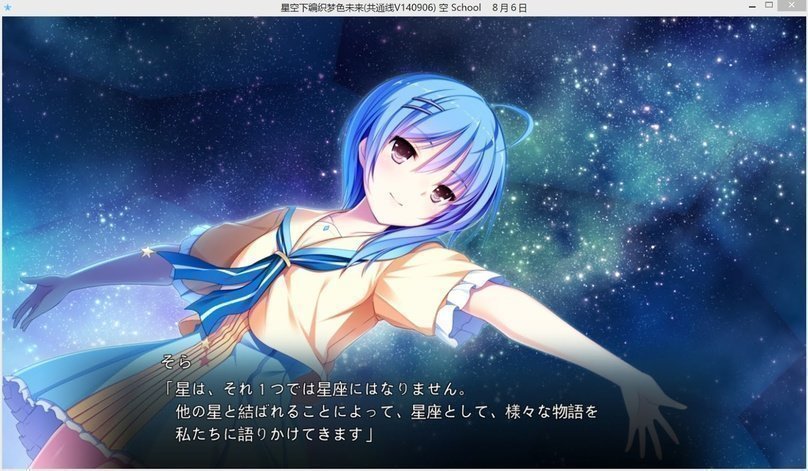
Hoshi Ori Yume Mirai’s plot is simple, and it doesn’t overlap much with the many galgames I’d played before. If anything it’s a greatest-hits compilation, fusing school romance with the postgrad life epilogue, plus a whole lot of the worries and solutions young people run into while growing up. Calling it a galgame that doubles as a life textbook is not an exaggeration at all.
A life textbook? A galgame? Funny, right?
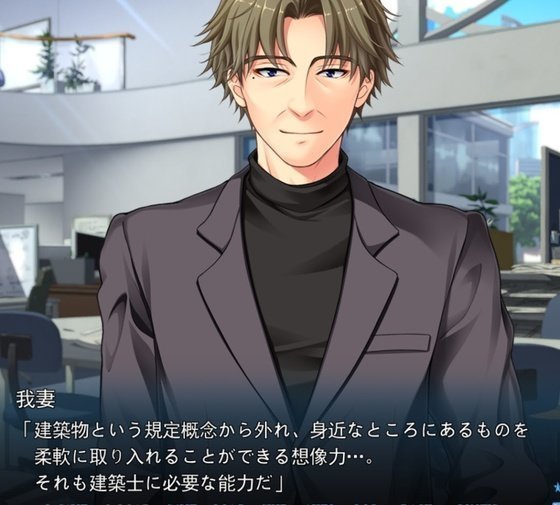
The game opens with the protagonist moving back to his hometown and transferring schools, meeting assorted childhood friends and classmates. He’s also got a goal: he studies architecture, and he wants to apprentice under the architect he admires, Mr. Azuma.
Naturally, the apprenticeship doesn’t get an explicit yes. The protagonist is fired up, wants to do big things under Mr. Azuma, eagerly shows off his accomplishments hoping for approval. Mr. Azuma just shakes his head:
“A young man your age should be doing what young men do. You may have talent, but a lot of things can only be done now. Come back to study this after you graduate — it’ll serve you better than starting right now.”
“But… isn’t it too late once I graduate?”
“You know I didn’t enter the architecture industry until I was 34. A late bloomer. Before that I was doing all sorts of things, completely unrelated to architecture. But when I finally started down the design path, all those ‘unrelated’ experiences kept me from taking a lot of detours. Meaning: your life experience always brings you valuable assets. So… you’re still a student. Enjoy school life properly, or you’ll be missing out on something huge.”
Holy shit, that makes way too much sense! Blew my mind, seriously!
So the protagonist takes Mr. Azuma’s advice, joins the student council, runs all kinds of activities with the girls he meets (his harem). The Tanabata festival is coming up, and the astronomy club and the paranormal science club have both opted out. The protagonist goes to persuade astronomy club president Aisaka Sora to join, and quickly learns she’s a strange and interesting person.
Her face is usually blank, but she’s obviously fanatical about the stars. Bring up astronomy or the constellations and she won’t shut up…
The protagonist also has some childhood encounter with her. Anyway, after a series of events he falls for Aisaka Sora and wants to confess…
The confession scene is written very realistically. He’s tossing and turning at home at night, can’t sleep for wondering whether Aisaka Sora has feelings for him. Then he hears she’s one of the most popular girls in school, gets confessed to all the time, and loses his confidence, hesitating over whether she’d even look his way…
Holy shit, this passage is so good it hit way too close to home
Eventually, through more back-and-forth with Aisaka Sora, he finally confesses. She agonizes for a few days, realizes her own feelings, and accepts…
Then it’s a long stretch of daily dates, building the Tanabata project together. There are setbacks, but he never gives up. When the cardboard observation hut turns out not sturdy enough, he thinks of using a soccer-ball structure, which even earns Mr. Azuma’s praise. He also keeps encouraging Aisaka Sora not to give up. His personality here is genuinely good — he never shows a “what do I do” face in front of his girlfriend, always composed and reliable. You know how everyone has moments of not knowing what to do — that’s when you most need someone to tell you what to do. That’s what a “reliable guy” is.
The astronomy club’s Tanabata project finally succeeds, and Aisaka Sora and the protagonist confess their feelings to each other under the starry sky. I figured the game was over at that point…
I was wrong.
The story soon cuts to the protagonist’s working life. After graduating he lands a spot at Mr. Azuma’s firm, and his dedication earns him some commendations. Aisaka Sora becomes a planetarium narrator. Now he starts thinking about his own trajectory: keep working at this firm forever, or try something new?
He asks his girlfriend Aisaka Sora for her opinion. Calmly, she says: “Your dream should be to be a creator, right? What a creator does is create a new era — your mentor succeeded through innovative work too. Creating an era might fail, you might lose everything, but there’ll always be plenty that doesn’t get lost. Whatever you do, I’ll support you.”
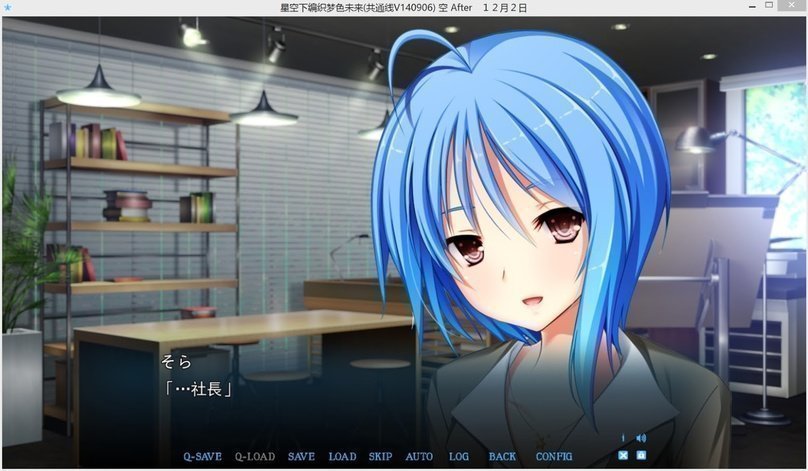
He soon chooses to start his own company, and his mentor Mr. Azuma supports him too. But starting a business isn’t easy…
First deal, second deal — problems keep piling up. He stays up late fixing them, and soon his body gives out.
Aisaka Sora notices, wants to quit her job to help him with the company full-time, and asks to marry him. He gently declines.
“The planetarium is your dream, isn’t it? I can’t drag your dream down over my own problems, and I can’t marry you just to pull you away from what you want to do.”
In the end he makes it through the rough patch, the company finds its footing. During some vacation, he invites Aisaka Sora back to visit the school.
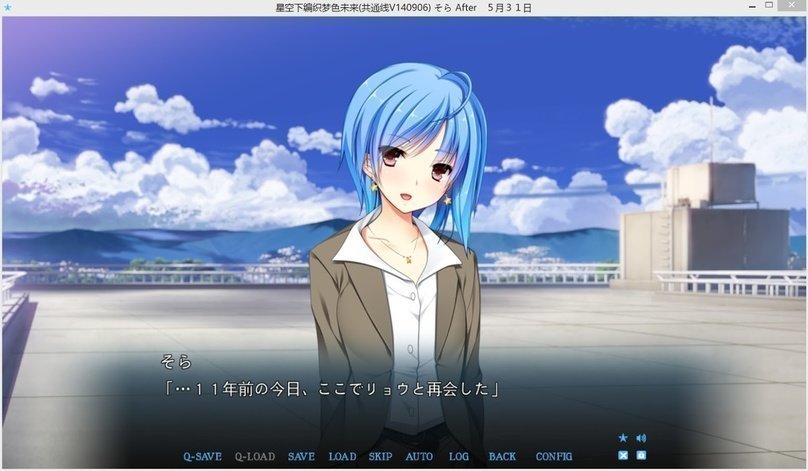
The two return to the rooftop where they first met — eleven years since that first meeting…
By now he’s established, and he formally proposes. Aisaka Sora tears up, says yes.
“Thank you for choosing me among all the stars in the sky.”
The route reaches its true End.
Honestly, finishing this route hit me hard. The life path in it is too steady, too real — nothing like the usual galgame plots where the protagonist gets tangled in conspiracies, runs into chuuni girls, builds a shameless harem. The protagonist here reminds you of people you’ve actually met. Just like the guy I mentioned at the start.
Sometimes I wonder if the game’s story was written from someone’s real emotional experience, it’s that true to life. The difference is that the plot still leans toward the sunny side — the protagonist never gives up on hardship, keeps working hard, takes school seriously.
And he’s got thick enough skin when chasing the girl!
Honestly, a guy like this doesn’t have much of a protagonist halo. For most college students, doing things seriously, flexing less, and having thick skin basically gets you onto his route. Maybe you need a little luck, but unless your luck is atrocious, you’ll land roughly there.
After finishing Aisaka Sora’s route I felt like I had no strength left for anyone else’s. From what I hear, Rikka — voiced by Ono Ryouko — is the most popular, and the others are more or less the same: school life -> life trajectory, maintaining that plain realistic style, crafting a fairly complete pure-love story.
Pure love… sure, I guess. Even though the game has plenty of H scenes — Aisaka Sora alone gets eleven — that doesn’t stop the story from being pure love. Young people, after all. Romance means fucking eventually…
The systems are standard fare, the art style is moe-leaning-but-somewhat-realistic. The artists deliver but take some getting used to — the two characters drawn by Koizumi Amane keep reminding me of a certain nukige… not that it’s a problem.
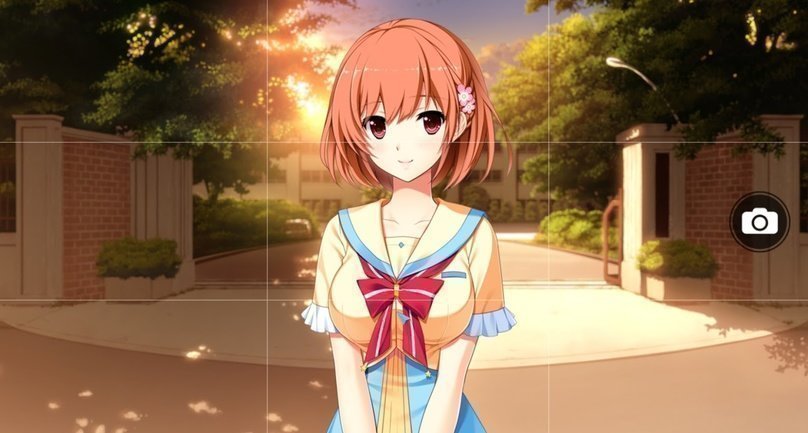
There’s also a smartphone you can play with in-game, though it doesn’t do much — just photos, which is to say screenshots. The in-game LINE presentation is fun too. Those are nice touches.

I’ve played plenty of dark, fantastical, delusional galgames, and Hoshi Ori Yume Mirai — this realistic-leaning pure-love work — hit me harder than any of them. So hard that after one route I didn’t dare start a second. Looking back on my own life against the protagonist’s, sometimes I feel I could’ve gone down a certain path, but some things threw me off course, and I ended up blaming fate or the unfair world.
Regret’s useless now, of course. Like Mr. Azuma says in the game: the life you’ve accumulated always brings valuable assets to whatever you do later.
There’s an English saying: There’s always a way. Life has no dead ends.
I’m always radiating negative energy while telling other people: the world is dark, but face the light anyway.
Where there’s light there’s shadow. Standing in the shadow, you still have to remember — at the other end of that shadow, the light exists.
That’s probably what hope in life amounts to.
Comments are hosted on the Chinese main site. This mirror is read-only.