Kimi e Okuru, Sora no Hana (キミへ贈る、ソラの花) Review
What Ghosts Envy
My take on whether ghosts exist has gone through several phases…
In elementary school, when I heard there might be ghosts in the world, I was terrified. I couldn’t even sleep after watching those cheap Hong Kong and Taiwan horror flicks, and local ghost stories were enough to make me afraid of the dark. Then I saw some behind-the-scenes footage of those Hong Kong/Taiwan horror movies, and I started spreading ghost stories myself, and after that I was never scared again.
Humans only fear the unknown and things they can’t control. That’s how I understand it. As for ghosts, humans can’t catch them, but they can’t deny them either. Some even go so far as to say ghosts have magic, supernatural powers, that they can control people and command wind and rain, which makes everyone even more anxious.
Later I developed a new understanding of whether ghosts exist or not: if people become ghosts after death and can run rampant in this world…
then wouldn’t the world be full of ghosts by now! Humans would’ve been wiped out by ghosts ages ago, right?
So after Hatsuyuki Sakura, I played another game about ghosts:
Kimi e Okuru, Sora no Hana is Cabbit’s second work — yeah, yeah, the same one as Midori no Umi last time. This time they dropped the artist whose art gave off a strong nukige vibe and had Yukie, the character designer for Chisa, who claims to be female, handle the art solo. From the outside it looks like a thoroughly heartwarming work.
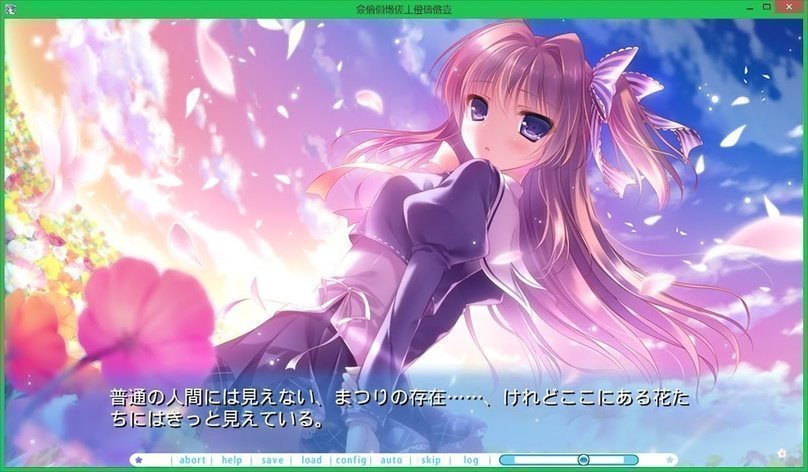
So is the story actually heartwarming? Trust me — if it’s not, you can come and fuck me up!
I don’t know how to translate the title Kimi e Okuru, Sora no Hana, because with my sub-kindergarten-level Japanese I have no idea how to put it properly. Based on the English in the game, it probably means something like “a flower of the sky that only you can see, gifted to you.” But whatever, that’s not the point. What we’re talking about is the story.
The setting is a school where ghosts and humans can attend and live together. The protagonist enters the school, meets all sorts of classmates — some human, some ghost — and has to study and live there… The characters are the shy ghost Yukihana, the protagonist’s little sister An, his close classmate Nishizono Kanade, student council president Minamisuono Hinagiku, and the ghost Matsuri Higase (I just call her Matsuri), who already knew the protagonist before he enrolled.
“Everyone, please get along well! Humans and ghosts may be different, but you can still become great friends!” the principal says in the opening speech.
Like most visual novels, the story starts with people getting to know each other and slice-of-life progression, and the characters’ personalities gradually fill out. Kanade is warm and helpful, Yukihana is always insecure and doesn’t want to be around others, the president is aloof, the little sister is caring, and most importantly, Matsuri is full of enthusiasm for everything, like a severe case of hyperthyroidism.
“Hey, hey! Let’s go shopping together! Shopping is so much fun!” “Ahh, look, look! The streets are packed with people, it’s so lively!” “The downtown is full of people coming and going, isn’t it fun! Let’s go around some more!” “Look! That’s the popular idol Cabbit-chan on TV! So cute! I want to watch her every day!”
And later, Matsuri’s enthusiasm for things starts to go beyond what normal people can imagine. Just the morning of each school day gets her incredibly excited.
“Good morning, Tousai-kun! Today is another happy day!” “Tousai-kun is finally going to eat a bento too? It looks really delicious!”
So the protagonist starts getting interested in ghosts and asks back:
“Aren’t you going to eat?”
“Ghosts don’t need to eat, and we can’t… Of course it’s fine, I feel happy just watching you eat!”
The protagonist is starting to find Matsuri’s behavior a bit impossible to understand. She’s a ghost, yet she’s like a child, happy about everything, never getting tired of it. Through their conversations, he learns more about ghosts.
Ghosts don’t need to sleep, and they can’t. Matsuri wanders around every night looking for TVs to watch. Ghosts can’t touch humans; they can only control simple objects through psychokinesis. Matsuri’s limit is making a pen float in the air. Ghosts can change their clothes and form freely, and their body form is the same as before death (so someone who died in a car crash…). Most ghosts form because they had an obsession or unfinished wish when they died, but once that wish is fulfilled, they disappear. Matsuri, like most ghosts, doesn’t remember what happened when she died.
In short, human understanding of ghosts is very limited. On this point, many humans can’t trust ghosts, including student council president Hinagiku. Seeing how close the protagonist is with Matsuri, she issues a warning:
“We can’t fathom the minds of ghosts. Ghosts have supernatural powers, and if they really wanted to do something harmful to us humans, we wouldn’t be able to resist. Given that, I think you should keep your distance from those ghosts… I know some people who were close to ghosts too, and later they all met misfortune. Whether or not ghosts really have ill intentions, ghosts are things left behind by the dead, so keeping your distance can’t hurt.”
At the same time, the human teacher Shimono holds a separate class meeting for human students and offers advice:
“Everyone knows humans have brains to control their behavior, but ghosts have no brains, so their behavior can’t be predicted or controlled. Humans may have self-control, but ghosts definitely don’t have any stable self-control. If things go on like this, when they encounter something exciting they’ll go berserk, so I suggest everyone be cautious.”
Despite all this, the protagonist still hangs out with Matsuri and the others as usual. He also curiously asks her why she’s so happy and cheerful every day, like an idiot.
“Because I’m happy!”
Matsuri’s answer is surprising, and it’s hard to understand where exactly the happiness comes from.
“Think about it — I’m someone who’s already dead. By rights I should never be able to exist in this world again, but now I can roam this world once more, looking at the sky, looking at flowers, looking at the people walking on the streets. Even though I’m a ghost, even though I don’t know when I’ll disappear, having now is already enough. After all, I can’t ask for more.”
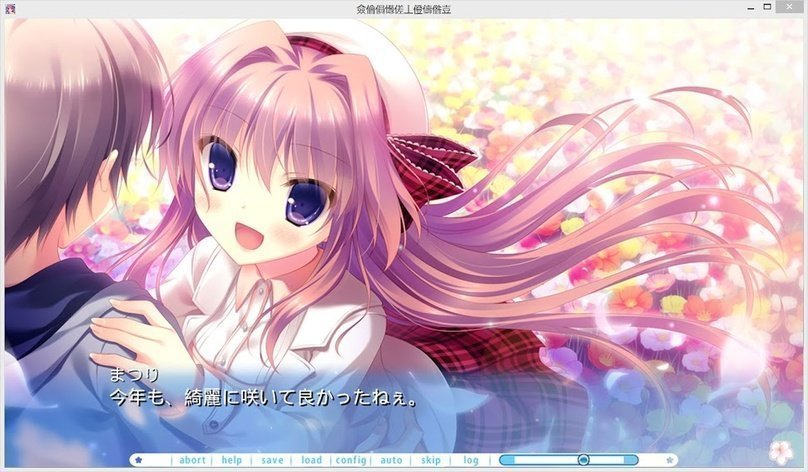
Things humans take for granted seem so precious to dead ghosts.
Later, as the story develops, Matsuri and the protagonist grow closer, and slowly they become lovers. At this point, the once-cheerful Matsuri starts to worry.
Because she’s a ghost and the protagonist is human, she can’t truly embrace him, nor can she feel him. As a girlfriend, this is distressing.
Then one day, Matsuri hears that a ghost has possessed the student council president, so she targets the resting president too and secretly possesses her.
The one with the president’s body and Matsuri’s soul immediately finds the protagonist and embraces him. This long-lost feeling of having a body again makes Matsuri greedy. The next day she possesses the president again, and the third day, and the fourth, until she even wants to imprison the president’s body and keep it forever.
At this point there’s a choice: whether the protagonist tells the teacher about Matsuri possessing the president’s body. If he does, she’ll be forcibly exorcised and disappear forever, and the protagonist will more or less forget she existed — that’s the Bad End.
If he chooses to tell the teacher, Matsuri gets talked back onto the right path by the protagonist, the teacher, and their friends. In this sequence, a ghost named Kirino plays a huge role — she seems to know something about Matsuri’s life before death.
At this point, Matsuri mutters Kirino’s name and slowly remembers the bits and pieces of her life before she died:
Matsuri died of illness. Before dying she stayed in the hospital, not knowing how much time she had left, just watching the patients around her die one after another. At first people came to visit her, but later fewer and fewer came, until finally no one did.
Before her death, Matsuri could see ghosts like the protagonist can. So she saw a ghost named Kirino. Kirino often chatted with Matsuri, and before long the two became friends. Then a little boy met Matsuri. The boy said his grandpa was in the next bed over.
The boy called Matsuri “big sister” and often talked to her — in fact, the boy became another friend of Matsuri’s, though he was human.
Finally one day, Matsuri’s condition worsened. Curiously, more people started visiting her then, and she knew she was dying, so her personality turned irritable. One day the little boy came to tell Matsuri he was leaving and wouldn’t come back.
“Grandpa is dead, I have to go. Bye-bye! Big sister!”
Matsuri didn’t know why, but she’d come to depend on the little boy in some way. After he left, looking at the strangers who came to visit her, she grew even more irritable. She took her anger out on Kirino.
“Go away! I don’t want to see you again, you unlucky ghost!”
The heartbroken Kirino left too. Later, Matsuri couldn’t even open her eyes or see anymore, and she died in pain.
Before dying, Matsuri was full of regret. She wanted to see Kirino again and apologize, and to see that boy again.
And so, carrying that obsession, Matsuri became a ghost.
Having never properly experienced school life, she got a new life in a way, so she’s full of happiness, smiling all the time.
After hearing Matsuri’s past, the protagonist says that he is that boy from back then.
Matsuri cries. The two people she’d been searching for all these years are finally found — one is Kirino, the other is the protagonist.
In the end, Matsuri apologizes to Kirino, and Kirino says it’s fine. She’s existed as a ghost for many years, and she never wants to leave; she just wants to be a ghost wandering forever.
Matsuri and the protagonist walk back to her old hospital room, to the bed where she met the protagonist, and share one last ghost-and-human embrace. Smiling, she disappears.
The protagonist, having lost Matsuri, falls into despair, but soon, on his way to school, he sees an angel in the sky with Matsuri’s face, who throws him a white flower and smiles at him:
That is Kimi e Okuru, Sora no Hana.
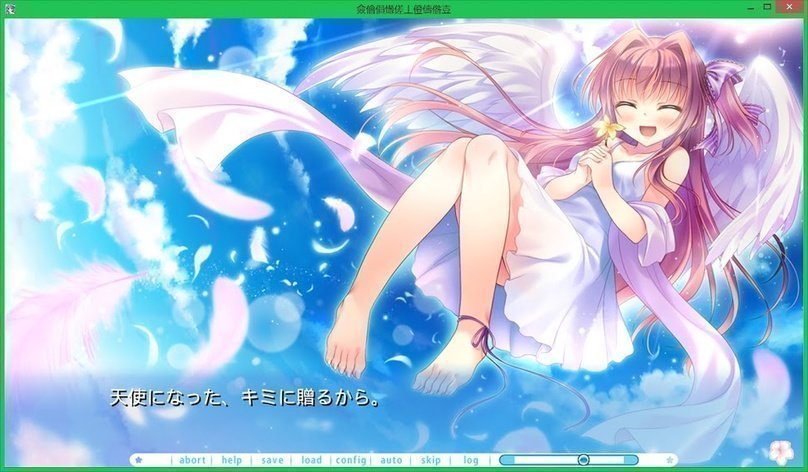
Of course this is just the main route. Matsuri’s other ending is that she chooses not to disappear and stays with the protagonist forever as a ghost, but I don’t think that really gets at the theme, so it probably doesn’t count as the True End.
Worth mentioning here is the ending of the other ghost, Yukihana. Before her death, Yukihana was bullied relentlessly at school and chose to kill herself, becoming a ghost.
As a ghost she’s very timid and afraid of people. The protagonist, out of concern, looks after her a few times, and for this only person who helped her, Yukihana develops dependence, which quickly turns into attachment, and then just as quickly into pathological love.
Yukihana starts despising anyone who gets close to the protagonist, clinging tightly to him — in short, she becomes a yandere.
Eventually the protagonist can’t take it anymore, and Yukihana, throwing caution to the wind, drags him into her own personal reality marble. Inside, the protagonist sees scenes of Yukihana being bullied in the past… except the people bullying her in the scenes are swapped out for people from the present — Kanade, Matsuri, and so on — and the protagonist feels even more sympathy for Yukihana.
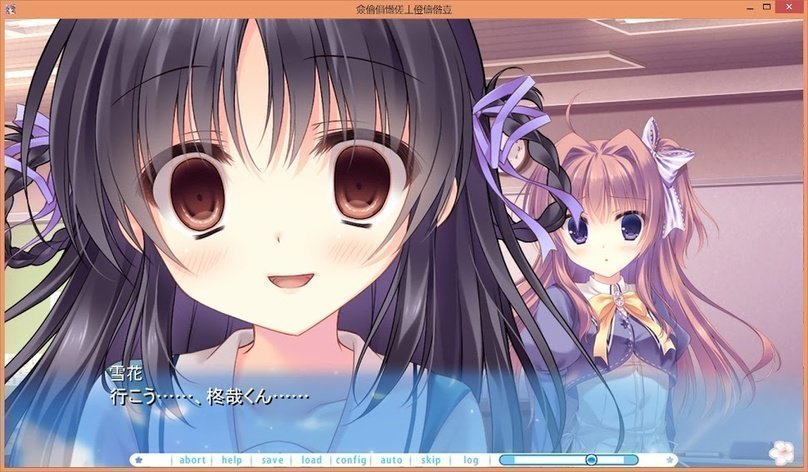
At this point there’s a choice: believe Yukihana or not. If he believes her, the protagonist will live forever with Yukihana in the ghost world, while his body sleeps forever in reality.
If he chooses not to believe, he wakes from the dream, Yukihana realizes her mistake and apologizes to everyone around her, expecting to be blamed but instead receiving care and forgiveness.
What Yukihana longed for was someone who cared about her, and that’s when she realizes so many people cared all along.
“If only I’d met everyone sooner.” Yukihana cries, her wish fulfilled, and disappears into the sky.
Story-wise, I think the Yukihana and Matsuri routes are the good ones. The president’s route, Kanade’s, and the little sister’s are all clichéd — I skimmed them and didn’t go through carefully.
I have to say, Kimi e Okuru, Sora no Hana is a big step up from the previous work, Midori no Umi. The art is more refined; the color palette has a strong rose tint but doesn’t overdo it. The BGM is absolutely great — violin accompaniment and simple piano build a strong sense of scene. That track Under the Wide Sky is absolutely a masterpiece of game music, worth listening to over and over.
Some people say this is a short-ish, minor work, maybe because the story is too short compared to so-called big titles, but I don’t think it’s a minor work at all. There are no obvious weak points in art, music, or story — you can’t call it minor just because there’s not much slice-of-life, right?
To fit the theme, each ending is represented by the language of a flower, somewhat like the tarot cards in Midori no Umi. If I had to name a weak point, it’s that the character personality shifts are a bit abrupt — Matsuri falling in love with the protagonist, Yukihana falling in love with the protagonist, they all just suddenly fall in love. Considering how short it is, maybe a bit more polish would’ve helped.
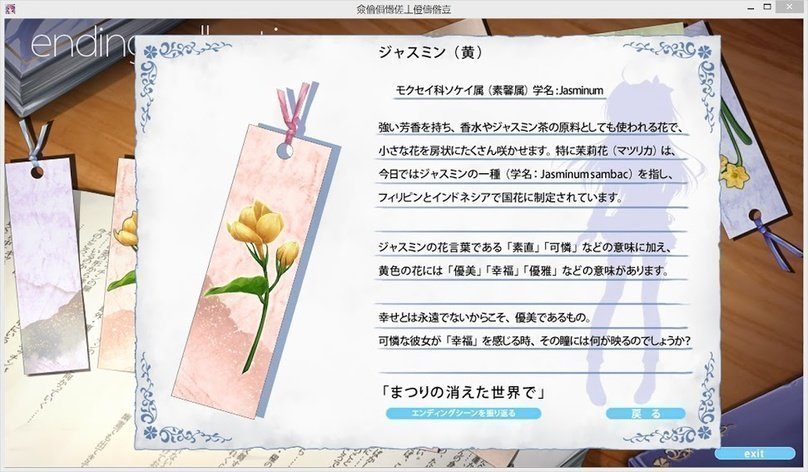
The story, by depicting love and interaction between humans and ghosts, advocates loving life. Playing this game gave me a firmer understanding of life. I’ve said it before: this world is messy and dirty, but it’s still worth loving, because I live here.
If I wanted to escape this world, there’d be no choice but death, and if ghosts really exist after death, then as a ghost I’d probably just endlessly regret my choice back then.
I’ve chatted with some people, and they say if ghosts really exist, their supernatural powers are enviable — walking through walls, changing clothes at will, not needing sleep, blah blah blah.
But before that, I think that as humans, we’re alive, and we still have the chance to embrace and enjoy this world, and the chance to pursue happiness.
These are things we have and ghosts don’t.
These are the things ghosts envy.
Comments are hosted on the Chinese main site. This mirror is read-only.