Butterfly Seeker (バタフライシーカー) Review
Butterfly Seeker
Butterfly Seeker (バタフライシーカー) came out back in March, and I only just finished it recently.
The main reason I didn’t want to touch it at first was the scenario writer: Nozomu Kaihara (海原望).
Kaihara is, I believe, a Liar-soft person. I’ve played a few things he worked on. I wouldn’t call them bad — it’s just that they always leave me with this strong sense of discomfort. Not from the art or the setting, more from the way the script and dialogue are written. So when I saw his name on Butterfly Seeker, I immediately didn’t want anything to do with it.
But I had literally nothing to play. I don’t like moege, I don’t like the stuff everyone else hypes to the heavens, and what I actually want is traditional mystery / puzzle-solving / story. Looking around, the only thing left from the first half of the year was Butterfly Seeker.
So I played it. And since there was nothing else I wanted to play, I played it pretty seriously. After clearing everything, my impression was: actually pretty good.
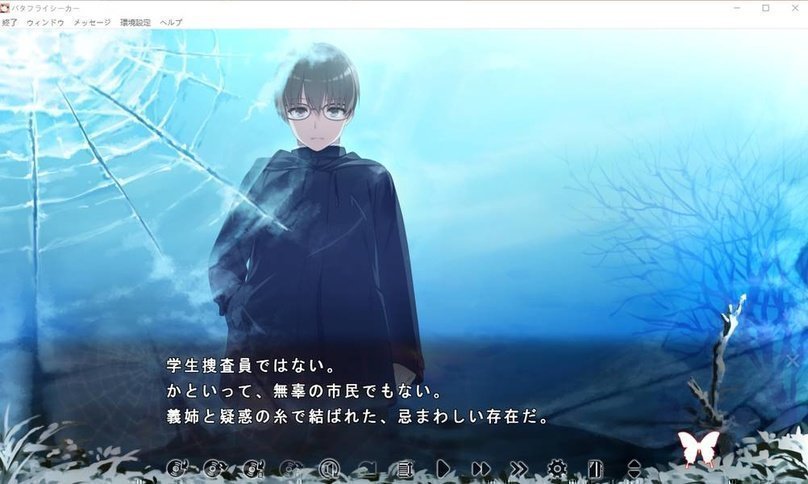
This might be the first Kaihara game I’ve been able to get through? Some people say Kaihara is a pen name of Meteo Hoshizora… but I’m not familiar with Meteo Hoshizora so whatever, lol.
バタフライシーカー — katakana, so in English it’s Butterfly Seeker. Literal Chinese translation would be “butterfly seeker” too.
At first I figured it was just a chuuni-sounding title, but after clearing the whole thing I got it — the title means a lot, and it runs through basically everything in the game.
The game opens by telling you the protagonist is a member of some special “student investigator” organization, currently looking into a serial murder case. The protagonist is a student, and so are the other “student investigators.” For secrecy they hide their identity at school by calling themselves the “Insect Cuisine Club.” No, they don’t actually eat insects — it’s just a cover.
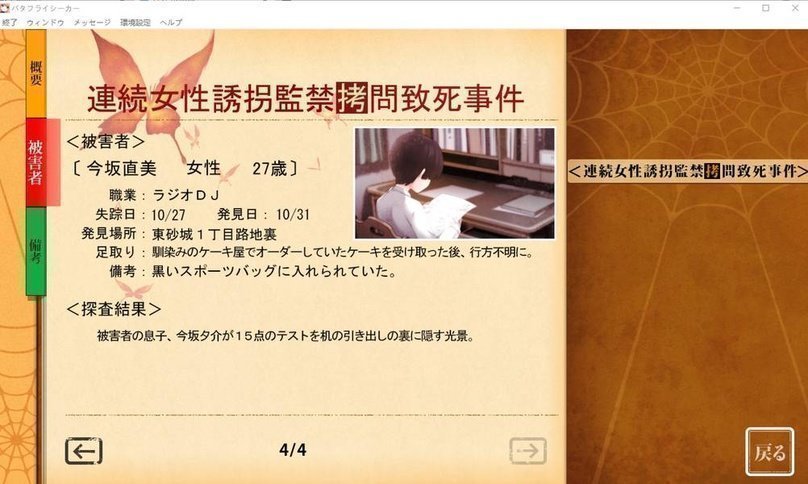
The first murder case they investigate is a serial one. All the victims are women — a DJ, a music teacher, a music student. Each one gets abducted and disappears, then a few days later the body turns up stuffed into a different bag. The corpses are covered in wounds, all made with knives and saws.
Here I should explain the protagonist’s ability: by touching a dead person’s belongings, he can see fragments of visions, and those visions are usually indirectly related to how the person died.
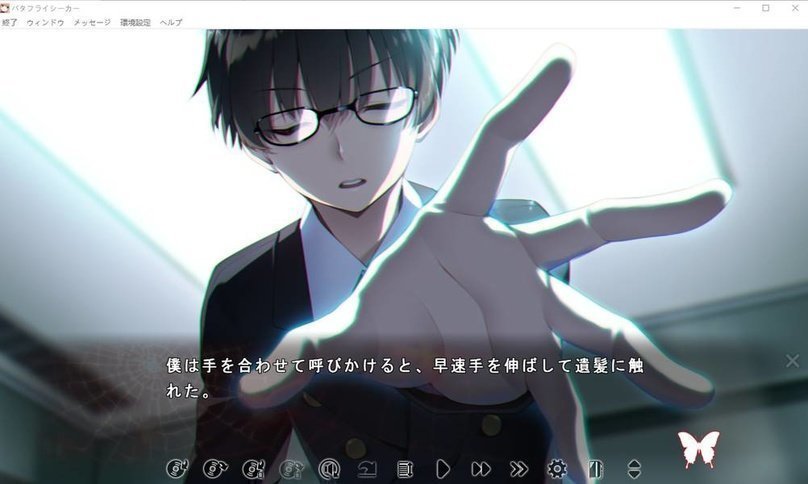
When he looks at the visions of these victims, he sees weird stuff — someone screaming their head off during a test-of-courage game, someone terrified right before getting hit by a car, and the dead person’s son goofing around inside her glasses case.
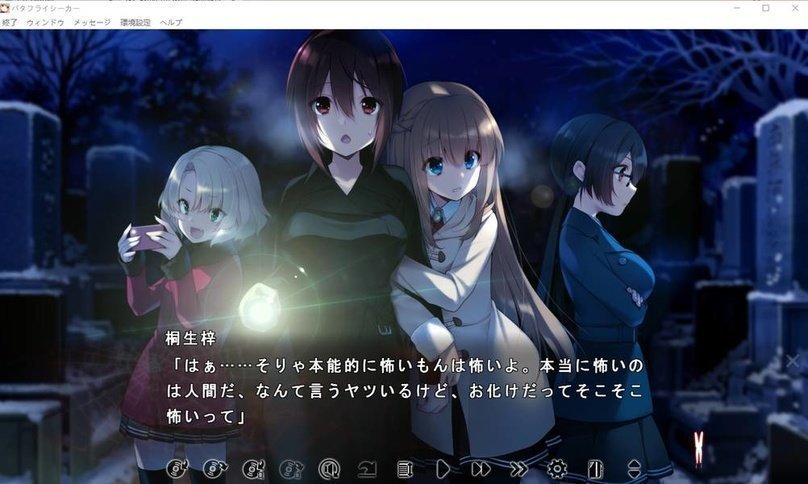
The case stalls. The protagonist even suggests imitating one of the victims by doing the test-of-courage thing themselves to see if anything turns up. Nothing. One club member even mischievously uploads footage from that test-of-courage night to a website.
There’s a lot of deduction in between, which I’ll skip. Eventually the protagonist spots what the cases have in common:
- Every victim had screamed at some point, because of some incident
- The sound of every victim’s scream had been heard by the culprit through some channel — a live DJ radio broadcast, a test-of-courage video uploaded online…
- The bags the culprit stuffed the victims into were all violin cases
So the protagonist reasons: the culprit hears a woman scream, abducts her, then uses her own body as an instrument, torturing sounds out of her with sharp tools like he’s playing a violin — and finally, depending on how satisfied he is with the screams, stuffs the corpse into a violin case of a corresponding grade and dumps it.
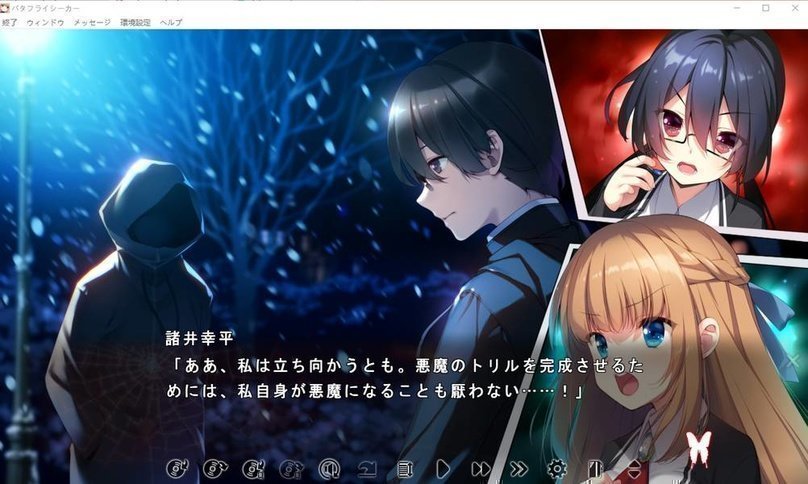
The culprit is clearly someone musical, and already a deeply twisted psychopath. The protagonist narrows it down to a musician who retired a few years back, and they catch the guy.
After cracking the first “deranged musician” case, the squad gets more cases, and the game branches: three cases, three heroines.
The Caretaker Abduction Murders
The first case is a series of abductions and murders in the city — young people, abducted for no apparent reason, bodies dumped a few days later. But the autopsies show that after being abducted, each victim received “a series of care.”
So you can infer the culprit abducted them, cared for them, and after caring for them a while, killed them and dumped the bodies…
After investigating, it turns out every victim had some contact with the scent of a “wintersweet” perfume. Digging further reveals the truth.
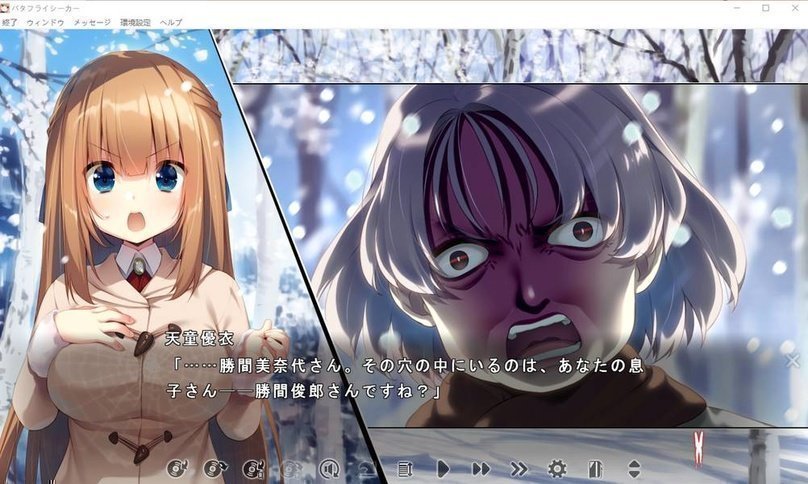
Turns out there was a rich woman whose son was frail and sickly, so she bought a villa in the mountains and lived there with him, nursing him every day.
But then for some reason she accidentally nursed him to death (or killed him, I honestly forget), and she refused to admit it was her fault, and lost her mind. She started hallucinating. Since the area around the villa was full of wintersweet, she began wandering the streets, and whenever she smelled wintersweet on someone she’d hallucinate that it was her child, abduct them, and start caring for them… When the wintersweet scent faded, the hallucination of her child vanished, and she’d frantically kill the person and dump the body.
The Indiscriminate Murders
The second case spans a long stretch of time — the earliest killing was years ago. The victims range from students to officials, from young people to old men, seemingly indiscriminate.
Investigating turns up that all the victims took part in a “find the rabbit” contest in a free art museum pamphlet put out by the city government. Simple contest, big prizes. The rabbit picture was drawn by a female painter.
A group goes to question the painter, and at the museum they find one of her works, “Water of Sighs.” There’s a deep sadness in it. The painter says she painted it out of grief over losing the person she loved most.
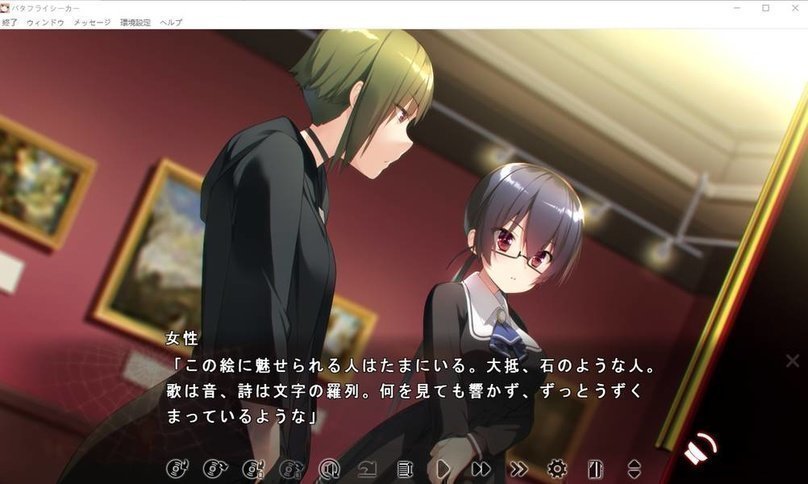
The protagonist starts looking into the men in the painter’s life and gets nowhere… but stumbles onto something else: the victims all seem to have color blindness, specifically blue-green color blindness. Because the “find the rabbit” picture gives different results for colorblind and non-colorblind people.
Finally, after his sister talks some sense into him, he realizes his biggest mistake: “the painter’s lost lover isn’t necessarily a man — she could be gay.”
A quick check cracks the case. The painter once met a female student and fell for her unrequited. Then the student was murdered. The painter looked into it and found the killer was blue-green colorblind, so she set up this “find the rabbit” trap, luring colorblind people in and killing them one by one, hungry for revenge — and the revenge carried on to the present, killing anyone regardless of age.
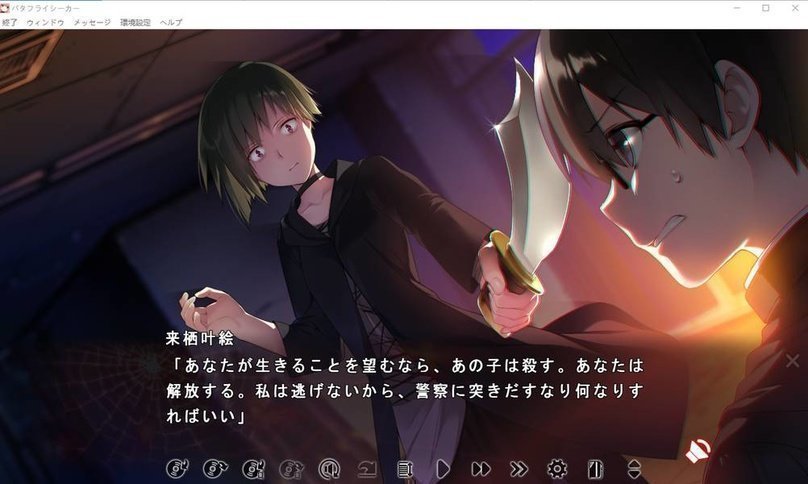
In the end the painter is caught. And the second person she killed was the one she wanted revenge on. Everyone after that was innocent. She seems to know it, but she also seems to have awakened some special taste for killing, and couldn’t stop.
The Robbery Murders
The third case is simpler. Another serial murder case, but each time, one item is stolen from the victim.
The protagonist investigates and finds the victims’ status keeps rising — ordinary people, then teachers, then politicians, then idols, more and more famous. And the stolen items aren’t especially valuable, just seem to have some personal meaning.

Then someone points out that this case seems to be the work of two people, with different killers taking different items — and most important, the items differ by color.
Two people, say A and B. A’s kills have blue items taken, B’s kills have red items taken. So it looks like A and B are competing over the killings, which is why the victims’ status keeps rising, and taking a correspondingly colored item is leaving a marker.
Finally one of the killers makes a critical slip: she’s the wife of one of the victims, and the item taken was something only someone very close would know about.
Find one killer and the other follows.
After clearing all three cases, the final True End unlocks — the last case.
The last case picks up directly from the first “caretaker” case — the mother who lost her mind, killed her son, then abducted others thinking they were her son and killed them.
The protagonist finds something strange in the case: the insane mother drank water contaminated by a “red butterfly” — she must have been poisoned by it. That butterfly, once it poisons you, makes you “obsessively fixate on something to the point of hallucination.” That’s why the deranged mother saw everyone with wintersweet scent as her son, and could kill so frantically.
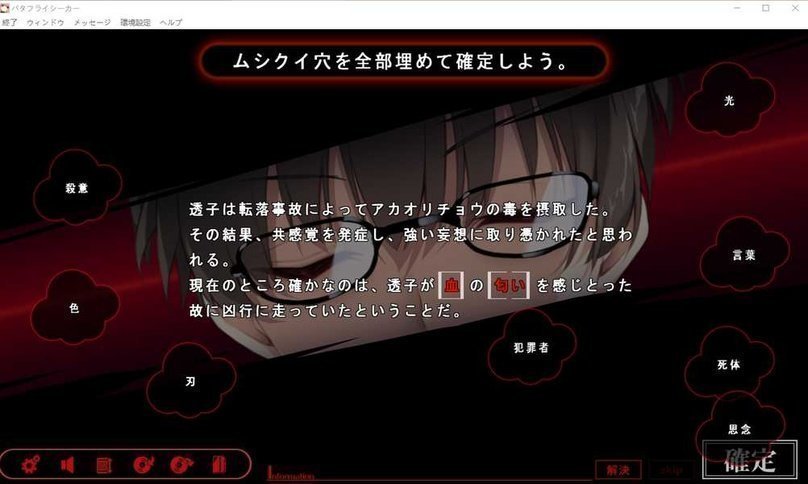
And the first serial killer, the violinist, was also poisoned by that red butterfly in a mountain valley somewhere, hallucinated, and saw any woman with a nice voice as an instrument, wanting to play a human body as an instrument — and so he killed too.
Here I should bring up the protagonist’s sister — she appears in the common route, and she’s the game’s biggest supporting character.
The protagonist was raised by his sister, and in his memory she’s an incredibly gentle person. But one day the police arrest her, calling her a “crazy killer” codenamed “Spider,” with at least 15 kills.
The protagonist can’t believe it — until he sees his sister kill the policeman who came to arrest her, right in front of him…
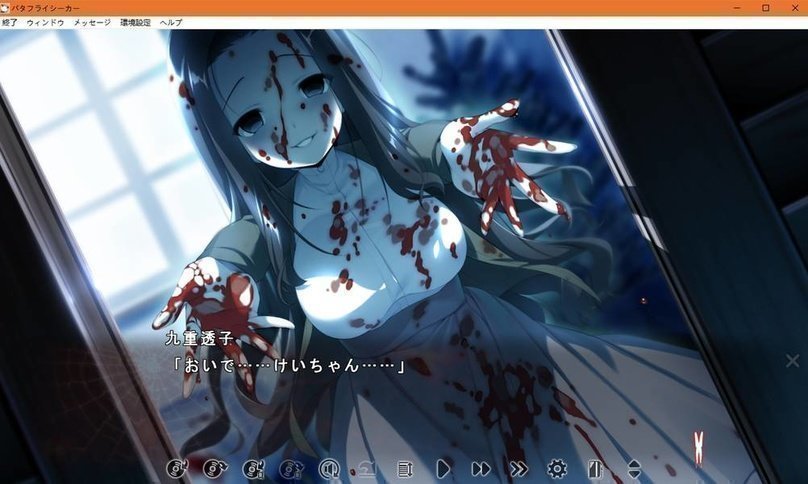
When his blood-covered sister smiles at him, the protagonist can’t take it anymore and passes out. When he wakes up, dazed, his sister has been taken away, diagnosed as mentally ill, and permanently confined. And when he recovers, he’s gained that detective ability — touching the dead’s belongings to see visions.
Meanwhile the protagonist never believes his sister is a killer, always feels she was framed… After seeing the butterfly-poisoned mother and the musician, he thinks he might be able to clear her name. And even though his sister is locked up, rumors are spreading in the city again of the “Spider” killer back in action — so the real killer from back then might be someone else.
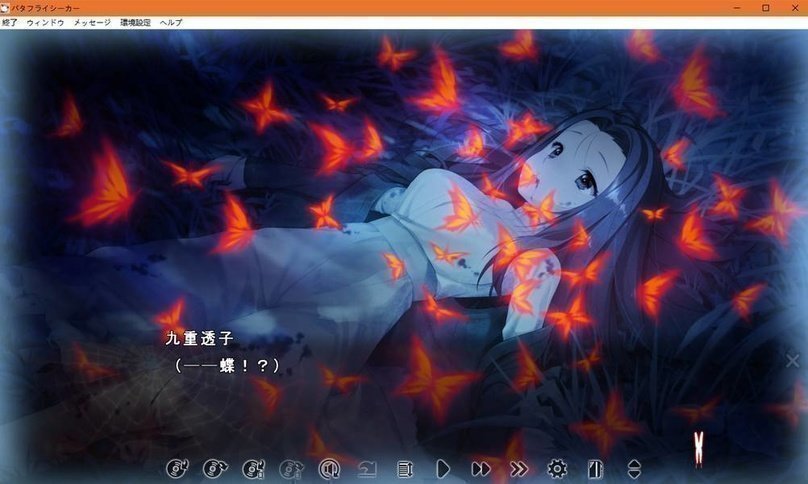
Investigating further, it turns out his sister really was affected by the red butterfly. She’d once had a butterfly enter her body in a mountain valley, and afterward hallucinated: whenever someone with the smell of blood came near, she’d see them covered in red butterflies, and a voice in her head would say:
“Kill him, kill him, he’s possessed by butterflies, he’s already dead, kill the butterflies to free him, or he’ll kill you.”
So, manipulated by hallucinations, his sister started killing — from an accidental kill to a full-on massacre, and she grew mad too.
And to keep those terrifying red butterflies out, after killing she’d put a spider doll she made into the victim’s mouth, and leave spiderweb-like symbols at the scene as a ward.
Then the protagonist notices: of the 15 murders attributed to his sister, more than half the scenes had no spiderweb symbol… but the victims did have spider dolls in their mouths.
He starts to speculate — do those scenes without the spider symbol mean someone was impersonating his sister?
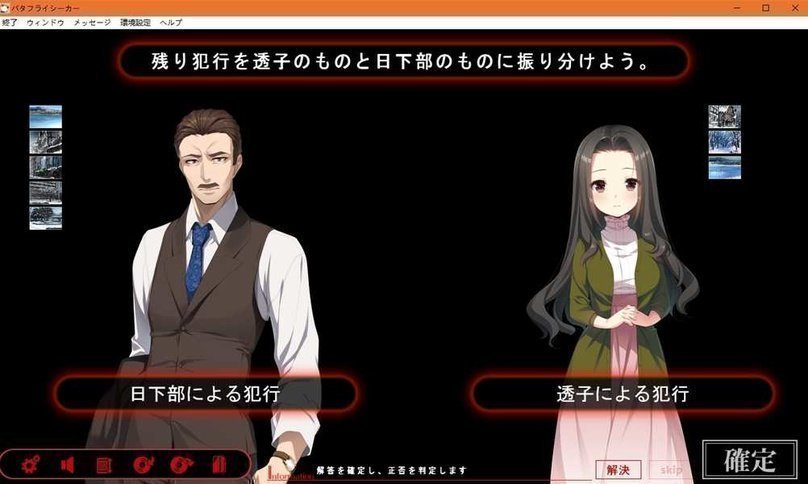
Then there’s a bunch of half-assed analysis and going in circles, and everything comes out.
The mayor has three kids — two boys and a girl — and these three little bastards have a twisted hobby: they like doing S&M to people. After their first accidental kill, they happened to see the protagonist’s sister killing someone, and hit on an idea: pin all the people they S&M to death from now on on the protagonist’s sister — just stuff a spider in the mouth.
His sister’s a deranged killer anyway, 8 kills or 15 makes no difference, and she’s genuinely mentally ill.
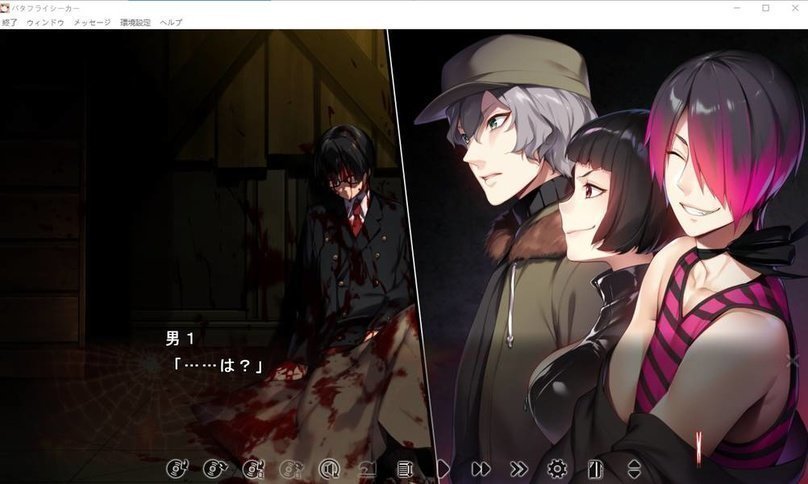
And these three brats are the mayor’s kids, so the mayor, for his career, helps cover it up, and it stays covered until now — and when the sister is locked up and the three brats kill and frame again, they slip up.
Naturally justice triumphs, his sister is cleared of 8 of the murders and gets a reduced sentence.
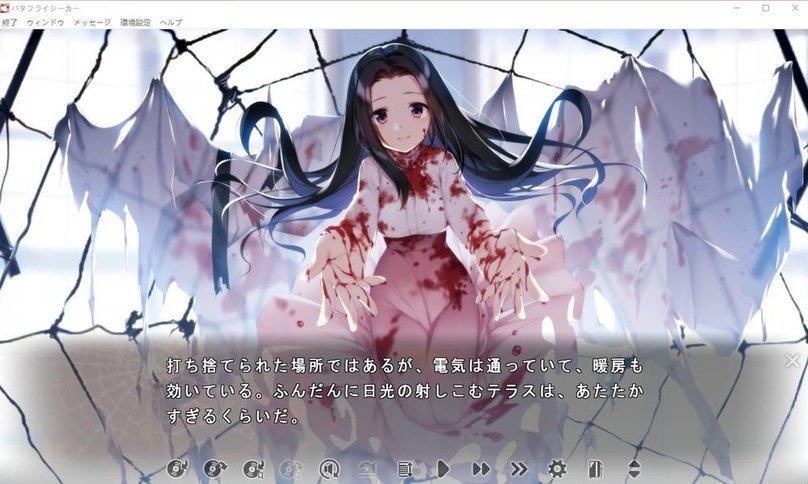
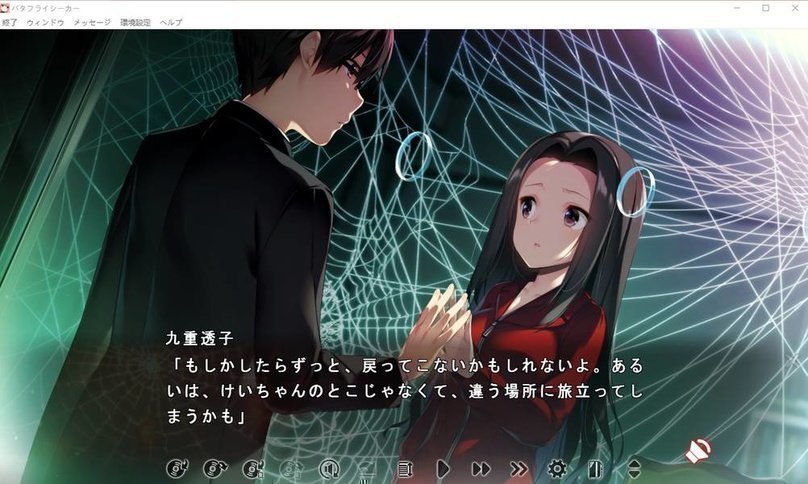
The protagonist says he’ll wait for his sister to get out, looking forward to their reunion, and the game ends.
Overall, Butterfly Seeker’s structure is very complete. Almost every setup gets paid off, the investigation of the three cases is genuinely fun, and combined with the protagonist’s ability it’s full of suspense — it really pulls you into the detective work. Compared with the clichéd loop of other so-called “detective games” —
crime -> gather evidence -> trial defense -> conviction
— Butterfly Seeker is clearly different. Its deduction is more like working backwards, and it’s actually closer to how real investigative agencies operate.
Butterfly Seeker is probably the most comfortable game I’ve played in recent years. The pacing is well controlled, the dialogue doesn’t waste words, there’s no idle chit-chat, and from start to finish you’re in the cases. “No dragging things out” describes it well.
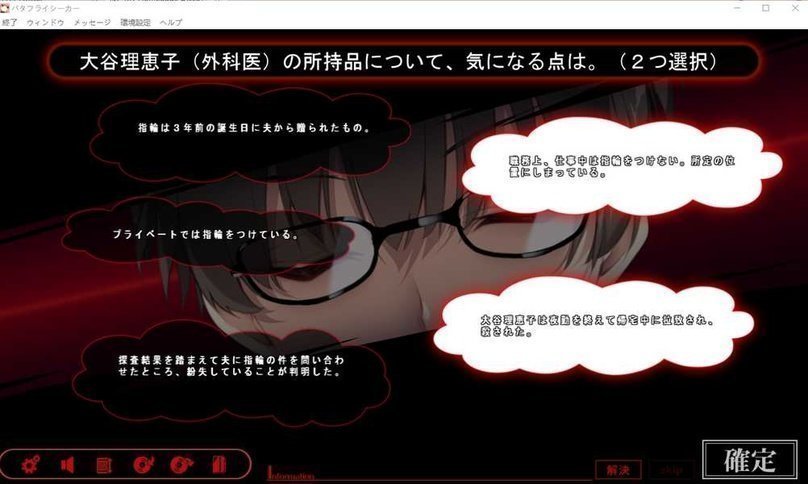
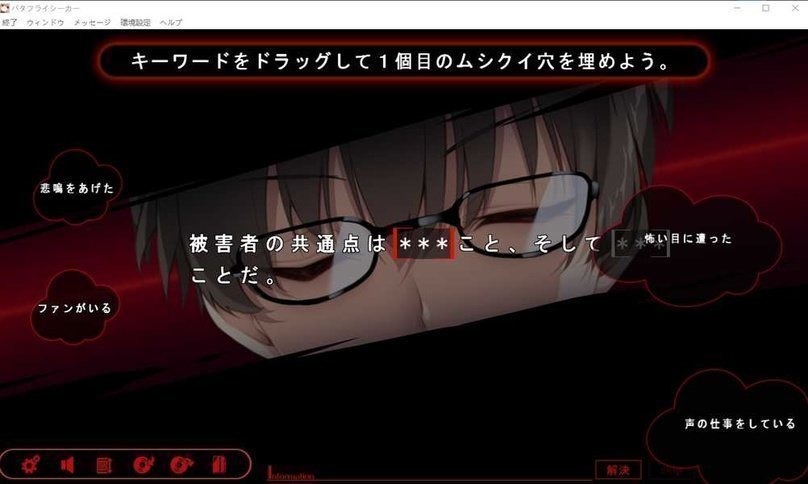
The choices are also worth studying — most make you actually think, and there’s a bit of a “fill in the blank” feel, like doing a quiz. Felt really fresh, and it supports drag-and-drop, which is fancy.
But the game has plenty of flaws too: the art style, too few CGs, not enough room for the voice actors to shine, and apart from the sister, the other characters barely matter — just background extras. And for a visual novel, there’s almost no romance — the only thing there is the protagonist’s attachment to his sister, which goes beyond family, so much that the final True End route is a veiled confession to his sister. I guess it counts as a fairly literary ending.
The one thing Butterfly Seeker does really well is the story and its structure. Everything else is at best average. That doesn’t stop me thinking it’s worth a try. Honestly, this script would have been better as an original anime, a novel, or a TV drama than as a game. And Butterfly Seeker keeps reminding me of Cai Jun’s Butterfly Cemetery — the narrative rhythm is very similar to Cai Jun’s, which won me over. Maybe the script had no budget, or maybe various other reasons, so it got compromised into a game. So players who like mystery detective novels should give it a go with a bit of imagination — it should be a good experience.
Of course, my retelling is extremely condensed. The actual game is far more complex, with all sorts of scenarios where the team gets caught up in danger, which players can see for themselves.
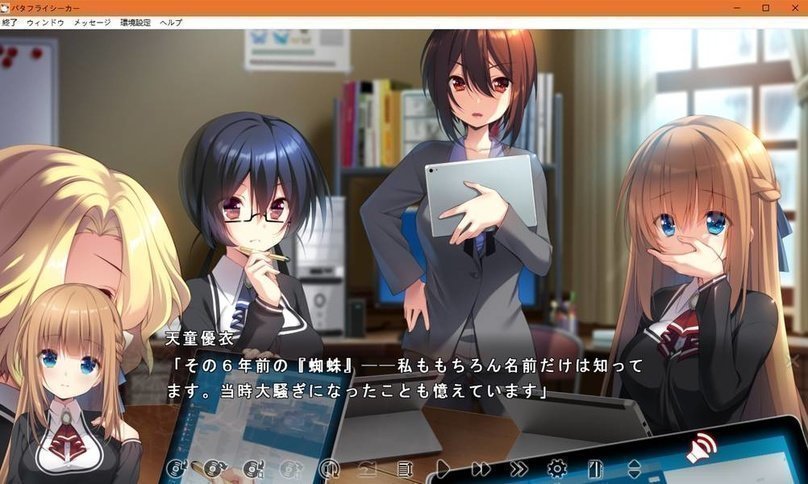
The script isn’t flawless either. The protagonist’s group is often off the IQ charts and constantly needs his sister to help him deduce, and the second half of the game is way too rushed — the final trial is glossed over with no payoff. Those are problems, but they don’t ruin the good parts.
Worth noting, the game has a lot of Bad Ends, and they’re actually worth a look.
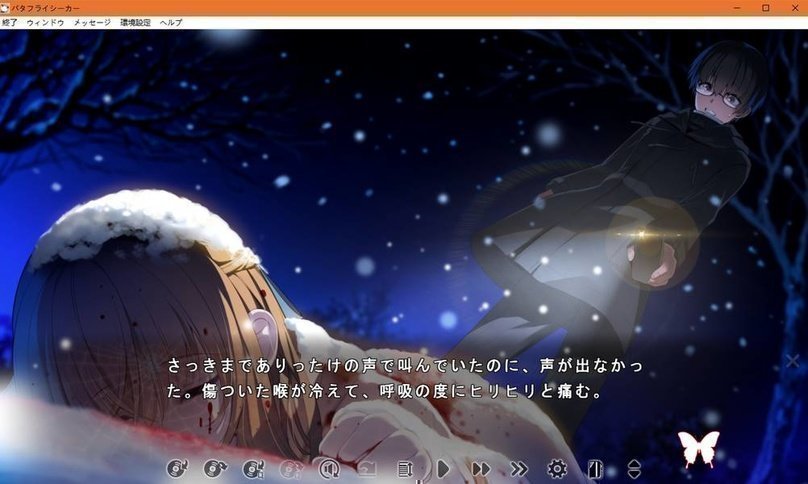
Come to think of it, the name Butterfly Seeker carries deep meaning in the game.
On one hand it symbolizes the protagonist’s detective ability: every crime is caused by a moment’s misstep between victim and culprit, like the butterfly effect, and his ability is to find the original instant of that butterfly effect — hence “butterfly seeker.”
On the other hand, there’s the red butterfly his sister showed him when they were kids. His sister was trying to catch that butterfly for him when it entered her body, which led to the later tragedy — and after all that searching, the protagonist finally clears part of her cases and finds the “butterfly” that belongs to his sister.

Butterfly Seeker — being able to come up with such a pretentious yet story-spanning title is genuinely rare among Japanese visual novels. That alone deserves praise.
At least it’s way better than those dumb chuuni names, right?
Comments are hosted on the Chinese main site. This mirror is read-only.