Dare mo Shiranai Tentai e no Namida (誰も知らない天体への涙) Review
Nobody-Knows Tears for a Celestial Body: A Case of Chuuni Tears
Everybody has some contradictions in them…
Some people love spicy food, but hate the fiery ring of death the next morning. Some people are scared of yokai, but can’t stop themselves from reading ghost stories anyway. Some people love games, yet spend every day watching someone else play on video and shouting “insane” along with the crowd. Some people love eroge, yet never actually play them—they just hang around 5ch and forums while other people argue about the plot, nodding along to things they don’t understand.
Like me: I love mystery and exploration stories, but I absolutely hate detective novels…
Why do I hate detective novels? Because most of them have already drifted away from reality and become a self-indulgent game for a small circle of people. It’s like doing math problems—someone sets the premise, someone else poses the question. As the rules get more explicit, the premise-setters get more twisted, and the angles get more bizarre, until later detective novels even start showing off “trivia” to make cases seem more mysterious with obscure knowledge. Meanwhile the protagonists of detective novels get less and less like actual human beings. To curb this unhealthy trend, someone came up with “Knox’s Ten Commandments” and “Van Dine’s Twenty Rules,” and the most hilarious one has to be Commandment 5: no Chinaman must figure in the story.
Why no Chinese people? Because most foreigners think Chinese people know kung fu—flying leaps, qinggong, all that nonsense. You could make up a story about how the victim died in some incredibly bizarre way, then reveal it was a Chinese guy using superpowers… which would be total bullshit.
Personally I more or less agree with Knox’s Decalogue and Van Dine’s rules—at least those consensual regulations make those “detective novels” seem a bit more solid. Even so, detective novels today are getting less and less readable; the tedious showing-off of trivia makes the genre dull, though there’s no shortage of diehard fans still eagerly discussing it. To me, the “detective novels” I like are the ones that include human nature and thought in the deduction, not machine-like cold puzzles.
I also hate “worldbuilding”—at least before I got into Japanese works, I’d never seen a “lore nerd.” If I need to first decode dull, dry exposition to understand a story, I’ll probably just turn around and walk away. Sure, Western stuff like DnD has its own version of that, but what actually spread this kind of system was approachable works like World of Warcraft that didn’t cling to rigid settings.
Put simply: hardcore stays niche. If you want more people to accept it, it has to be approachable. That doesn’t mean approachable equals low, though—on the contrary, making hardcore stuff approachable takes even more effort. If you insist on being rigid and throwing away the feelings of the masses, what’s left is just a small circle playing by itself, and then the people in that circle start going more and more insane…
At least from the outside, that little circle looks insane—or just boring.
The same logic applies to galgame. The type of galgame I hate most is the kind built on piles of lore. A story that could be explained easily insists on wrapping itself in some super badass-looking lore shell so you feel how sophisticated it is. In reality it just looks like terminal chuunibyou. If you’re doing stand-up comedy, a bit of chuuni is fine, but pulling this in a serious work, forgive me for saying so, probably only fools kids under 13. But galgame is mostly R18, isn’t it? So doesn’t that mean it can only fool people over 18 whose minds are stuck at 13?
“Chuuni” and “fantasy” are separated by a single thought, and the gap comes down to the writer’s skill. Unfortunately, another writer seems to have fallen into the “13-year-old cult” with this game called Dare mo Shiranai Tentai e no Namida.

Dare mo Shiranai Tentai e no Namida literally means: tears for a celestial body nobody knows about. The writer isn’t exactly obscure—Sakuraba Maruo, who a while back wrote a game Japanese players hyped to the heavens: ChronoBox.
I didn’t play that game, though. Why? Because it was too boring.
Too boring. Genuinely, really too boring. The writing in that game was exactly what I described earlier: written strictly in detective format. From the start, it’s just character self-introductions that are painfully one-note—everyone comes out for their little entrance, but none of them leave any impression. It felt like writing code to declare variables: cold and emotionless. Combined with the fact that almost everyone in that game had the same pose and the same face, I literally couldn’t tell who was who. After falling asleep several times, I finally abandoned that game…
Afterward it felt like the sky was blue and the water clear, and wow, the real world is so beautiful!
So when I started Dare mo Shiranai Tentai e no Namida, before long I instantly felt that familiar boredom return…
And not just boredom—also “what the hell is this.”
I kept wanting to understand: just what the hell is this stupid game even saying?

But by the time I finally figured out roughly what the game was about, the game was over. ED rolled.
That was when I realized this game is sold in volumes, and this first chapter is at most a prologue.
Holy shit, that’s the shortest prologue I’ve ever seen—it EDs without saying a damn thing. Even Kiri’s prologue from before was way longer than this, okay?
After sorting things out for a bit, I roughly understood what this game was trying to say.
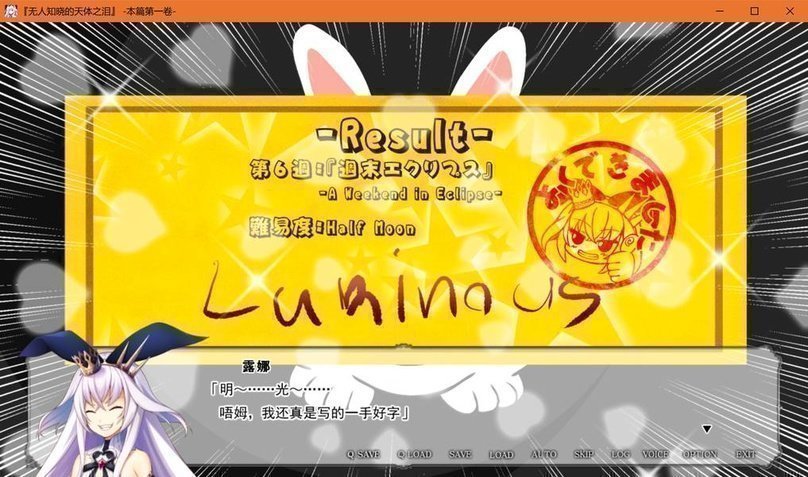
Basically: the protagonist, a guy who likes detective novels, plays a game with something that calls itself God or a deity or whatever. The game doesn’t state it outright, but it’s probably the old Loop routine—each Loop someone dies, and the protagonist commits the crime himself and acts as the culprit or something.
Most of that is my guess, because the game really says nothing. It only says the protagonist has an ability called Oracle, and got something like points from an antagonist named Luna, voiced by Akino Hana.
Maybe the ending is that after Looping around a bunch, the protagonist finds release from this detective game and discovers the mastermind behind it… which, again, is my guess.

The game only costs 500 yen, but it explains nothing at all. Every line is either boring chuuni or flexing, and it’s frantically piling on lore—I don’t even know how to evaluate it. If not for the author’s history of high praise, I’d straight-up call this the embarrassing dark-history essay of a terminal chuuni high schooler.
Volume one covers just that much. I hope later developments slap me in the face, but I won’t be following it. I’ll play it again if fate allows.
One bit of gossip worth mentioning, though: where did this game first get released? By the Moshou translation group.
And Moshou was pretty bold about it—they released a translated version and even deleted the Japanese Launcher, so you can only see their Chinese version.
Actually, I played that “Chinese version” too. Listening to the Japanese voices while picking apart errors in the Chinese subtitles was pretty fun. Moshou’s translation quality was at least a little better this time—not machine translation like before, though there were still plenty of mistakes, including errors left by pinyin input… “吐露真心” written as “屠戮真心” and all that.

Honestly, I think Moshou and this game are a pretty good match. The game is boring and chuuni (at least chapter one), and Moshou is pretty unhinged, so the two fit together perfectly. If you don’t know Japanese, after finishing this absurdly short volume one you’ll be just as confused as someone who does.
And one last complaint: Moshou mistranslated the game’s title, didn’t they…
Comments are hosted on the Chinese main site. This mirror is read-only.