Review: Grado SR225e
Grado SR225e: A Moving, Passionate Sound
If I had to name the first time music truly got to me, it’d be my senior year of college.
Back then my daily IEMs were the Audio-Technica CKM55, and I was listening to an Alan song. The rhythmic drumbeat paired with her sweet, slightly melancholy voice hit me with a wave of sadness. I remember thinking: how is this singer’s voice so clear, so sweet — it’s like the sound itself carries emotion, and I got infected by it.
Later, the CKM55 that had been with me for so long had its cable snap, and then I found out the thing was discontinued. I’ve gone through plenty of earphones since, and it’s rare to find a pair that separates bass from vocals while keeping the highs clear. More importantly, that feeling of passion was gone. Even with booming bass, sweet mids, and crystal highs, there’s always something missing — that one bit of passion.
I’m no good at the mystical side of this hobby. That “passion” is probably expressible in a frequency response curve, but how exactly you tune for it, I couldn’t tell you. Luckily, the Grado SR225 headphones gave me what I wanted.
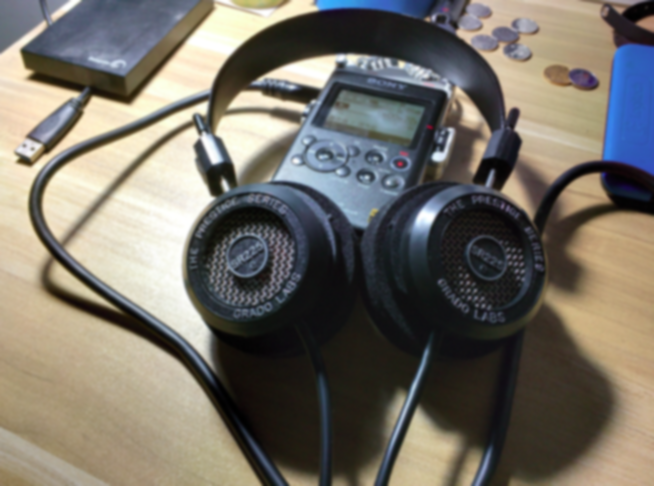
There’s no shortage of Grado marketing copy and legends. This small American company’s products are, as everyone says, ugly, with thick cables and crude packaging — a headphone and one big block of foam, nothing else. Even the foam is weird: no center, just a ring around the edge. Still, it’s not uncomfortable to wear, and it’s a lot better than the clamp of the Q701.
Of course, it’s an open-back headphone, so everyone around you can hear what you’re listening to. Quiet home use is a given. Forget the looks — let’s talk sound.
The latest version of the Grado SR225 now has an E at the end of its model number, and it comes with a small plug by default instead of the large one, so you don’t need an adapter anymore. There are supposedly other improvements too; I don’t know the details, but overall the latest version is a lot more convenient than the old one.
As I said earlier, the Grado SR225e brought back that legendary feeling of being moved by the singer’s emotion. Maybe that’s exaggerating a bit, but it really does hit you. Grado’s tuning leans toward all-rounder: there’s bass but it’s not heavy, the highs are on the bright side — a bit sharp and clear, honestly — and the midrange vocals are dense but sit slightly far away. They don’t press right up against your ear like Audio-Technica or Phonak IEMs. The result is that at first listen nothing stands out, but after a few styles you get the feeling that “it all sounds pretty good.” There’s nothing it’s suited for and nothing it isn’t.
But the genre the Grado SR225E suits best is music with a strong rhythm. Ordinary rock and tracks with heavy drumbeats are rendered to the fullest by the SR225E.
The first thing I listened to was Nao Toyama’s Darling Baby. The heavily rhythmic track came through full of infectious energy — electric guitar and drums packed with rhythm, and Toyama’s singing even more passionate. Then I tried Yoshino Nanjo’s version of Mermaid festa vol.1, again full of rhythm and passion, with the singer’s flowing turns especially prominent. Just intoxicating.
Of course, a lot of people rave more about Grado’s handling of Western rock, so I gave Skillet’s Comatose a listen. The male vocal is indeed dense, still bursting with rhythm and infectious, and the violin accompaniment woven through the track stands out sharply.
No wonder it’s called “the most passionate headphone.”
So what exactly is passion? From my experience, it’s Grado’s trick of pulling that dense vocal slightly back — not pressing right against your ear, not the studio-recording feel of a monitor, but like you’re at a concert and the singer is bouncing toward you. Full of life and fire.
I tried a few tracks with very sparse accompaniment to gauge the SR225E’s raw ability. Aside from the dense-but-slightly-distant vocals, which barely count as a strength, both the highs and lows are just passable. But it’s exactly this three-band performance that, cobbled together, produces a sound that moves you.
So is the Grado SR225E an all-rounder? I’d say it comes close to handling everything, but not quite. For live recordings or piano-and-vocals, a monitor like the AKG Q701 would be more suitable. And personally I don’t think the SR225E is right for folk or jazz. Honestly, I still can’t stand country folk or jazz — most of that music lacks a clear rhythm, and rhythm-less, slightly languid styles just give me goosebumps…
Lately the Sennheiser Momentum has been popular, and a lot of people describe it as having “the old Sennheiser sound.” What that old Sennheiser sound is, I don’t know; I’ve only heard the MX500 and don’t remember how it sounded. From descriptions it’s probably fairly light and soft — highs average, lows average, mids average. I haven’t heard much of Audio-Technica’s full-size headphones; supposedly some models have killer female vocals. But thinking about what I actually listen to, real piano-and-vocals tracks are few and far between — most have obvious rhythm. Just like how many people swear they’re in it for the female vocals, buy a pair, listen through Tsai Chin and Hotel California, and end up back with Jay Chou and ACG denpa songs. A headphone that handles nearly everything, like the Grado SR225E, is probably a good choice.
Comments are hosted on the Chinese main site. This mirror is read-only.