Koi ga Saku Koro Sakura Doki (恋がさくころ桜どき) Review
Cherry Blossoms, Shinigami, and Love Fairies
Mashiroiro Symphony’s tagline goes: what color are boys? What color are girls? And when a boy and a girl fall in love, what color is love itself?
Koi ga Saku Koro Sakura Doki’s tagline goes: a girl who can’t fall in love, and a boy with no interest in it — if the two of them fall in love, what happens to the world?
Alright — Palette and 和泉つばす teaming up again. The title still has that high-class, faintly bittersweet ring to it, that pure longing-for-love vibe. That’s what I figured at first too: Koi ga Saku Koro Sakura Doki (恋がさくころ桜どき) is nothing more than a plain… school… boy-slowly-works-his-way-through-the-heroines story. A little sweeter at most, something along the lines of Sena Airi’s and Uryuu Sakuno’s routes. What’s the worst it could do? Drag things out like Kanna Sana’s route?
Except that’s not true at all!
Koisaku’s story opens in the same lane as Mashiroiro Symphony — and since the scenario writers aren’t the same person, the resemblance starts to feel like deliberate imitation. The protagonist is once again the rich, handsome type everyone loves to hate (okay, I can’t actually confirm the rich part). Right from the start he’s surrounded by a brocon little sister, a naive childhood friend, a disciplinary committee chair who’s into him, and a student council president who’s made it explicit she wants to hunt him down and date him…
男主小时候出过一场车祸,好像是死了,死的时候见到了死神姐姐。姐姐告诉他,他不该死,应该继续活下去,还要让周围的人露出笑容。于是男主认定自己的命是别人给的,没资格谈恋爱,只能奉献。
“I’m not someone who deserves to fall in love. I won’t fall in love. I just want to make the people around me happy, to make them smile.”
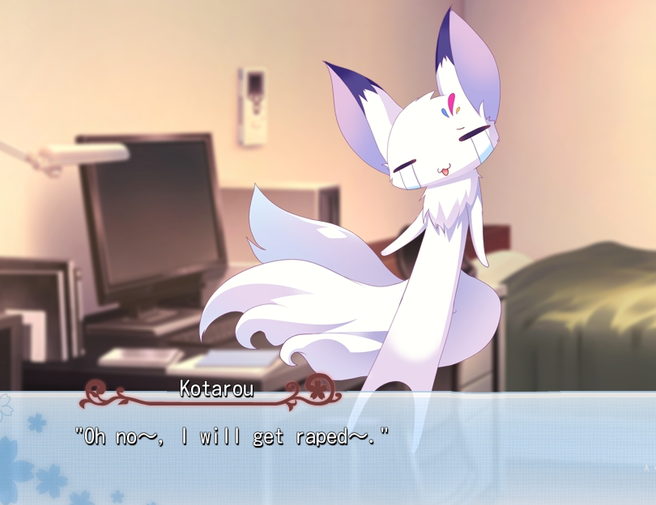
Our protagonist delivers this kind of flexing line, flat-out turning down every request to get him a girlfriend — and then a shinigami named Tina, who’d been sitting up in a tree, shows up at his house.
“I’m the fairy of love, so I’ve come to make your romance happen.”
And that’s how the story begins.
On my first run through the common route, there was basically nothing of value to see. Most of it is just the protagonist’s day-to-day life, and how he’s surrounded by girls everywhere—even his own mom is head over heels for him—while he wears this grim, long-suffering face and insists he doesn’t want romance. Tina is staying at the protagonist’s house, and every day she does nothing but sleep, occasionally popping up to nag him to hurry up and find a partner. And the protagonist keeps living his boring days just the same, until someone asks him why he never smiles.
So the protagonist tries cracking a smile, and…
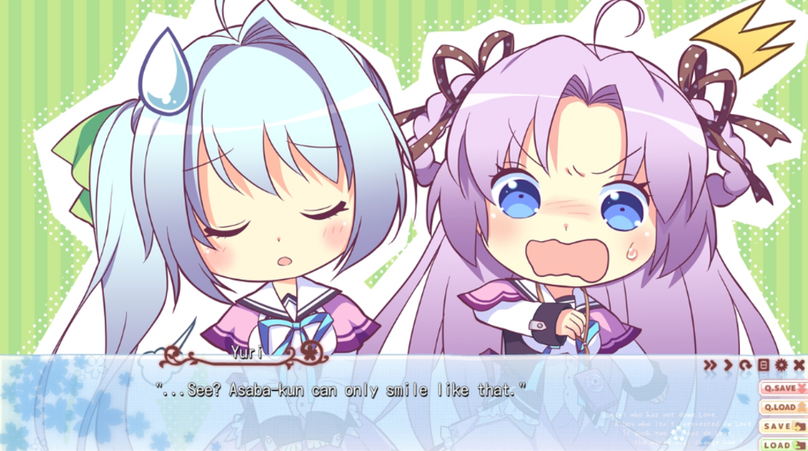
So in the end he thought it over and decided to go look for his own romance—at least so his smile wouldn’t be this creepy. He also accepted student council president An’s invitation and joined the student council. Because before that, An had already tried every trick in the book to get the protagonist onto the student council.
Honestly, the common route looks like it has nothing going on, but once you’ve finished the game and look back, you realize it’s packed with foreshadowing.
Broadly speaking, three problems:
Why is Tina sleeping every single day? Why does the student council president keep pestering the protagonist to join the council? And why does Tina, who clearly carries a shinigami’s scythe, insist on calling herself a love fairy?
So pretty soon the game hits its route split, and it’s as blunt as Mashiroiro Symphony: during the swimming event, whoever you go look for is whose route you enter. Worth noting here — apart from the student council president Anzu’s route, and Tina’s route after Anzu’s, the other routes have nothing to do with the main plot and don’t resolve any of the earlier foreshadowing. That doesn’t mean they’re bad, though.
First up is Konami’s little-sister route. Asaba Konami is Asaba Yuma’s sister — the protagonist’s sister, and apparently a blood-related one at that. A real imouto! Personality-wise she’s a lot like Uryuu Sakuno from Mashiroiro Symphony: slow, deliberate way of talking, a bit of a snark streak, and she’s got some small schemes going on. But her route ends up feeling pretty different from Sakuno’s.
First, in her route, the little sister nails down her own feelings for the protagonist. He figures he’s her older brother, so he can’t accept it, and starts dodging her and avoiding her in every way he can. Then she launches an all-out assault, and along the way she catches warnings from plenty of people, the infirmary teacher included, because whether you look at it ethically or think about the kids they’d have, romance between a blood-related brother and sister just isn’t allowed.
But the little sister never gave up her assault on the protagonist—night raids, morning attacks, the works. Eventually he couldn’t take it anymore and agreed to try dating her as lovers for the time being. Except, you know, the whole brother-and-sister thing can’t be made public, so they can only get affectionate when nobody’s around.
And so the problem shows up fast: the protagonist is way too popular, girls keep confessing to him at school, and the female friends around him are always getting handsy with him too. His sister’s jealousy grows more and more obvious, but since the relationship can’t go public, all she can do is throw inexplicable tantrums.
Eventually the little sister couldn’t take this kind of relationship anymore, and her feelings collapsed.
“I can’t take it anymore. If this keeps up, I’ll start being jealous of every friend around me, and the more jealous I get, the uglier I’ll become. And if I keep getting uglier, I’m scared you’ll leave me. And if you leave me, then there’s no point in me living!”
His little sister’s final confession finally gets through to the protagonist, and he realizes he’s in love with her too. The two of them officially start going out, and the last hurdle they face is getting the people around them to accept it.
Obviously the student council people wouldn’t say anything. The hard part is Aoi-san, the adoptive mother of the protagonist and his little sister.
When it came to the idea of the siblings being in love, Aoi absolutely refused to accept it. She called it nonsense, and said it would be a betrayal of the protagonist’s dead parents. In the end, Tina summoned the spirit of the protagonist’s dead father, who personally told Aoi what his parents had actually thought.
Even though the protagonist’s parents eventually gave their blessing, in the end Aoi-san still chose to separate him from his little sister and transfer schools, cutting off all contact by force.
“If you two are still in love three years from now, then I’ll accept it.”
Naturally, it ends on a Happy End: three years later, on that slope, the siblings hold each other and become a real couple.
Put simply, the sister route’s plot twists and turns like crazy. It’s one of the few I’ve come across in recent years that actually dares to lay out the real problems a blood-related little sister romance runs into—genetics and eugenics, plus the adoptive mother’s fierce opposition. It all feels real. The hard-won love makes you sigh, and it also makes you genuinely think twice about this kind of brother–blood sister relationship. This isn’t a “fuck the sister just to fuck the sister” plot. You can really feel that Konami is taking part as a little sister, not some random girl waving a sister flag.
Next up is the disciplinary committee member Yuri’s route. Yuri actually had feelings for the protagonist from the very start, but she’d convinced herself that since he already had his childhood friend Mio, she shouldn’t be the one to butt in. Then one incident changed everything: while the protagonist and Yuri were dealing with some confiscated handcuffs, they somehow ended up cuffed to each other… (don’t roast me, it’s the premise, the plot demands it). The two spend a whole day stuck together, including sleeping at night.
The forced close contact leaves Yuuri unable to control her emotions, her heart racing nonstop, and the protagonist realizes he’d never noticed before just how cute she is. Eventually Yuuri’s older sister Hanako picks up on something being off with her little sister and pushes her to confess to the protagonist—even though Hanako has always been tsundere-hostile toward him, which is really just tsundere (think Sana Inui). At the same time, Yuuri has this habit of playing the version of herself that other people like, caring way too much about what others think. She quits her modeling job, even though she really loves being a model.
Mio, meanwhile, had long since noticed that the protagonist was in love with Yuri, not her. But when the day of Yuri’s confession arrived, Mio witnessed the whole thing and still broke down crying, turning on her heel and running home. Yuri’s confession succeeds in the end, and she and the protagonist become a couple. Mio cries it out for a day, then gets past it and goes right back to being Yuri’s friend.
Of course, the story can’t end here. What follows is a whole week of Yuri and the protagonist openly flaunting their love, their honeymoon phase practically ignoring everyone around them. The protagonist stops looking after his little sister, and Yuri stops paying Hanako any mind. Eventually Hanako’s jealousy boils over and she blows up—and Yuri doesn’t even notice what’s wrong, just assumes Hanako has always had a bad temper and gets mad at everything.
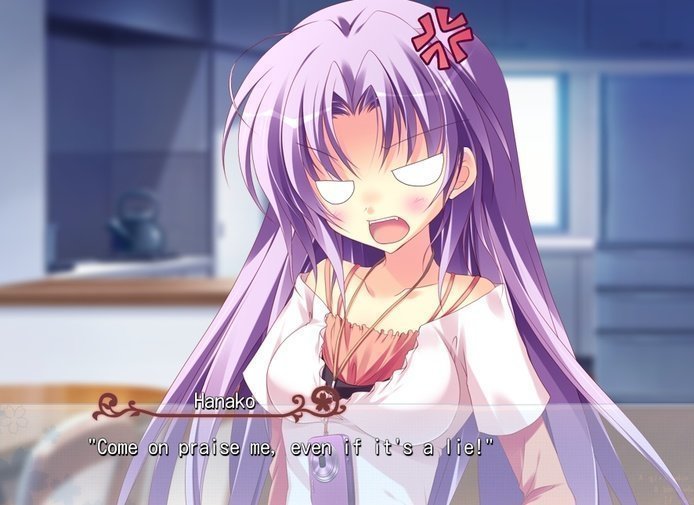
At that moment, another shinigami, Hebelion, found Hanako and told her that her life wouldn’t last much longer—if she could get her sister and the protagonist to break up, he’d consider extending her lifespan.
At first Hanako thought it was a joke, but then she realized this shinigami was the real deal, and she panicked. Truth is, she’d been a little jealous of her little sister since they were kids—her sister was better than her at everything. Now she was about to die, and all it would take to buy more time was getting her sister to break up with her boyfriend. That didn’t seem like such a big deal.
So Hanako starts deliberately sabotaging the romance between Yuuri and the protagonist, but pretty quickly she realizes her little sister still cares about her—and that even the protagonist isn’t as unreliable as she thought. She drops her plan, while Herbelion flippantly remarks that her own life is almost up.
That’s when the protagonist seems to overhear this, and Yuri senses something too—she breaks up with him.
“Now that we’re dating, you don’t even look at the people around you anymore. You even canceled plans you’d made with your little sister just to go out with me. I can’t accept that.”
The protagonist also thinks the two of them need to think things over properly, and accepts.
They broke up, and Hanako’s life is no longer in danger. After graduation, the protagonist chooses to date Yuuri again, and Yuuri happily accepts, while also restarting her modeling career. The story reaches its Happy End.
Hanako’s scenes make up almost half of this route, including the protagonist working through his tangled feelings for her, written in real detail — so much that I honestly wondered if there was a Hanako route, especially with Hanako voiced by Kiritani Hana. And then… nope, there isn’t one.
Goddammit, I can’t accept this.
Compared to Yuri’s and Konami’s routes, the childhood friend Misaki route is a lot simpler.
Mio has had androphobia since she was little, and the protagonist often helps her out with it. She’s a fujoshi just like Hanako, but Mio also has the purest heart of anyone. The relationship itself plays out pretty conventionally, and her androphobia only gets resolved at the very end of her route.
Back when they were kids, the protagonist and Mio got along great. But other people’s gossip got to him — he decided boys shouldn’t be hanging around with girls, so one day on the way home he slapped away Mio’s outstretched hand and ran off home…
And after that, the protagonist got into a car accident.
Mio kept blaming herself. If only she’d called out to the protagonist a second longer back then, made him run a second slower, he wouldn’t have gotten into that accident.
So every time she comes into contact with the protagonist, she feels like crying, and the memory of him dying in that car crash right in front of her comes flooding back.
The resolution is pretty fatalistic too. Tina has Mio deliberately pick a fight with the protagonist, ignore him, and then surprise him with a cake on his birthday. On the big day, the protagonist finds out Mio was never actually mad at him, and while he’s sprinting toward her all happy, a car comes barreling in.
This time Mio didn’t hesitate — she shoved the protagonist out of the way and took the car herself.
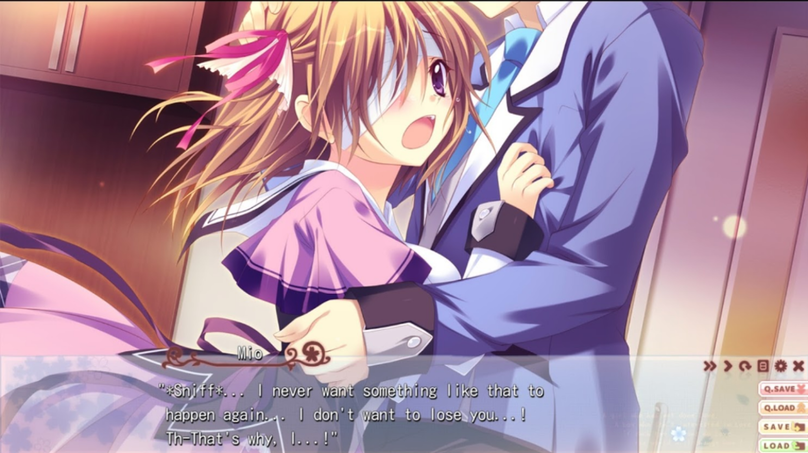
Even though she was badly hurt, Mio wasn’t dead. The protagonist didn’t abandon her over it—he kept looking after her. And before she knew it, Mio realized she’d stopped crying whenever he touched her.
Honestly, Mio’s route is the worst in the whole game. Though every game has that one route that’s comparatively not so great.
Last up is the Kōhō Anzu route. The romance between the protagonist and the student council president starts from his side—she’s been teasing him from the very beginning, but when he actually confesses, she still hesitates.
Why is that?
Because Kamio Anzu is a shinigami, and she’s also the mentor of the love fairy Tina.
From the very start of the game, student council president Kōgami An gives off the impression of being seriously capable. Why? Because she’s half shinigami, half human—her father’s a shinigami, her mother’s human. She’s got two personalities inside her: one is Kōgami An, the other is the shinigami Ellen. Normally An handles the president duties, while Ellen takes care of the shinigami work.
A shinigami’s job is to reap the souls of the dead, and after reaping, the memories those souls held in life get absorbed by the shinigami. In other words, Kamio Anzu carries the memories of countless people inside her—plenty of elites among them—which is why she comes off as absurdly capable and universally skilled. She’s carrying far too many people’s memories, and she became student council president because she reaped a student’s soul and took it upon herself to fulfill that girl’s wish.
Kannagi An is hesitant about the protagonist’s confession. She’s a shinigami, after all—ageless and undying—and she’s seen far too many tragedies. If the protagonist got involved with her, nothing good would come of it for him.
More importantly, Shinkō Anzu says Tina has an older sister named Lina. When they first met Tina and Lina, Shinkō Anzu started by teaching Lina to serve as an apprentice shinigami. One day Lina reaped the soul of the protagonist’s mother and gained her memories, and later Lina encountered the protagonist at the moment of his death.
The memories of the protagonist’s mother inside Lina start to take effect. Lina, as if treating her own son, gently gives her life to the protagonist and wishes him happiness.
Lina just vanished like that, her life becoming the protagonist’s life. And before she disappeared, Lina told Shinou Anzu that she absolutely had to make the protagonist happy.
Shinpo An feels responsible for Lina — after all, she was the one who dragged Lina into being a shinigami. So from the moment she first saw the protagonist arrive at school, she decided to help him: pulling him into the student council, keeping him by her side, helping him at every turn, hoping he’d fall in love quickly and find happiness.
“So yeah, I only got close to you to help my friend Lina, and even so… you still want to confess?”
Naturally, the result was that the protagonist fearlessly went ahead and confessed to Lina again, and the two of them ended up together.
“I’m a shinigami. You might die of old age and I’d still look exactly like I do now.”
“Isn’t that the best thing ever?”
The Anzu route reached its ending.
The Shinpou Anzu route doesn’t spend much time on the romance itself — most of it is solving the mystery, basically picking up the questions left hanging from the common route. The flashback scenes in Anzu’s route are actually handled really well, but it comes up a bit short on the emotional side. Though given that Anzu’s route is probably a lead-in to Tina’s route, I can understand why.
And finally, the game’s True End: Tina’s route.
Tina’s route unlocks only after you finish the Anzu route, and it’s simple and straightforward…
The setup: two months after the protagonist meets Tina, the love fairy, he still hasn’t fallen in love. Tina’s getting antsy, so she starts prodding him to get a move on—but he’s got zero interest. So she just starts studying the whole thing with him instead: what even is love, anyway? And one thing leads to another…
The protagonist realizes he actually has some feelings for Tina, but more in the vein of a protective older brother. That is, until one time he hears Tina call him “big sister” in her sleep.
This was weird, so the protagonist went to ask Anzu Kamō (神鳳杏) and learned the truth:
Actually, Tina took over from her older sister Lina as an apprentice shinigami, but Tina herself has no interest in being a shinigami—she thinks it’s cruel. And Tina knows that her sister Lina sacrificed herself to save someone. The moment Tina meets the protagonist, she just knows: her sister’s soul is inside him.
“My sister says love is a wonderful thing. Alright then, I quit being a shinigami. Starting now, I’m a love fairy.”
Tina had found herself a new goal.
“Tina boarding at your house wasn’t a coincidence—she actually really likes her older sister.”
That’s how An explained it.
So the protagonist comes to understand where he’s from, and it tears him up. He never expected Tina to feel that way about him, and at the same time he thinks she’s a pitiful thing, so he starts being gentler with her.
And so, before you know it… the two of them fall in love (sorry, but this part of the story is genuinely nonsensical).
And going by the setting, Tina is the same age as the protagonist (which is why the setting is such a handy thing)
After they start going out, Tina still doesn’t really get what “romance” is supposed to be. Her older sister Lina told her it’s a wonderful thing—it makes people happy.
Tina somehow ends up feeling happy just like that. It’s also why she doesn’t want to be a shinigami—seeing the pasts of the dead makes her miserable. In practice she’s only ever reaped the souls of cats and dogs; she won’t reap human souls.
Soon after, there was a day when Tina slept the whole day and never got up. The protagonist found it strange — but Tina often slept in and wouldn’t get out of bed, so he simply figured she was just being a sleepyhead.
“The shinigami are immortal because they have to keep reaping souls. Tina hasn’t reaped for so long that all she can do is sleep more to keep her body existing—otherwise she’d eventually disappear, wouldn’t she?”
Kannagi An and Heberion saw Tina and said something that shocked the other protagonist: if Tina doesn’t become a Shinigami soon, she’ll disappear.
The protagonist starts teaching Tina how to be a shinigami. She agrees, and reaps the soul of a girl who isn’t very old. The same day she does the reaping, Tina angrily slaps a classmate of the protagonist’s, Hida Sou, across the face.
So it turns out that the dead girl, Koharu, was not only Hida Sou’s cousin but also his ex-girlfriend.
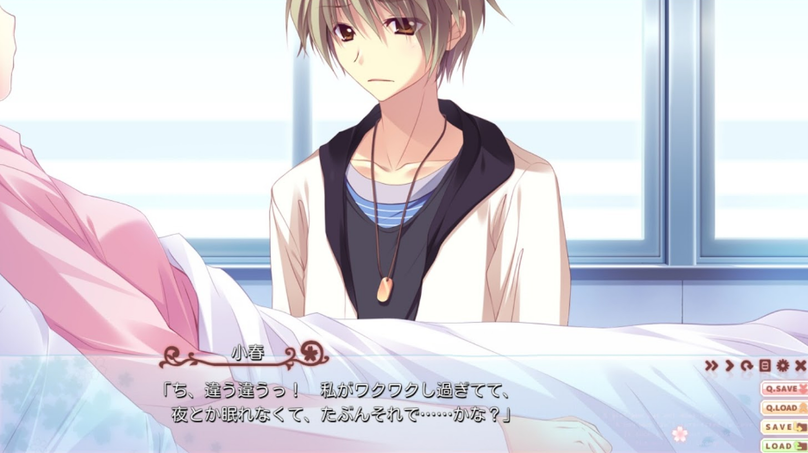
Not long after Koharu started dating Fuda Sou, she took to her bed. At first Fuda Sou still came to visit her, but eventually he stopped showing up—and just as Koharu’s condition was getting worse and worse, he went so far as to break up with her.
Koharu died resenting Fukuda Sou.
The protagonist finally blew up at his good friend — and later, that friend, Sō Futa, showed up at the funeral too, crouching in front of Koharu’s grave.
“I know I did something wrong too, but… when I saw how much weight Komatsu had lost from the pain, I got so scared. I couldn’t bear to look at her, so…”
Hida Souya was eaten by regret too. That was when Tina appeared and told him about Koharu’s wish before she died,
“She still loved you right up until she died, even though you two had broken up.”
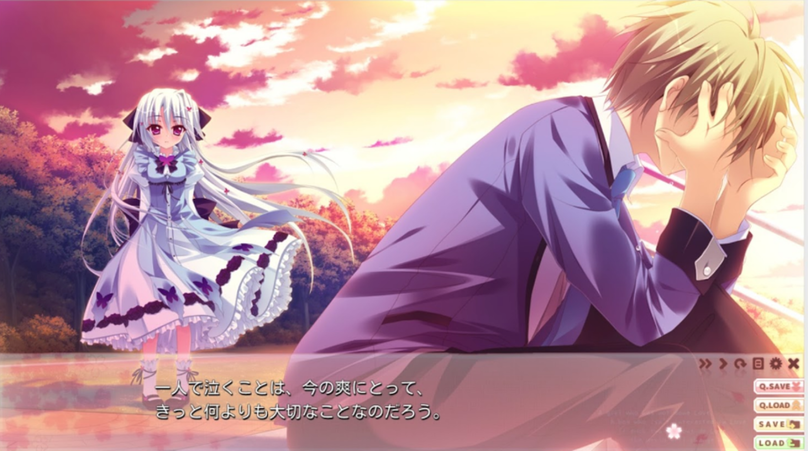
Hida Sou completely broke down and cried.
Later, Tina tells the protagonist that she lied—Haru’s feelings weren’t just love for Hida Sou, there was also a curse-laced grudge in them.
“So what exactly is love, anyway? How can she love him and hate him at the same time? Didn’t big sis say that love is nothing but happiness?”
The protagonist doesn’t answer.
After that, Tina fell into a deep sleep once again and wouldn’t wake up.
The old shinigami looked on again and found that even though Tina had reaped the human souls, it was too late—her disappearance was already a foregone conclusion.
“Like a vessel — Tina is already full of holes. Pour water in and it’ll just leak out, won’t it… She didn’t absorb anyone’s memories. She’s going to disappear…”
The protagonist watches over the sleeping Tina, and in the end she finally wakes up.
Before she disappears, Tina wants to go out and wander around with the protagonist.
The protagonist tells Tina he likes her, and asks her not to disappear. Tina smiles and shakes her head,
“Now I get it. This is what they call romance.”
“Romance means sometimes getting together, sometimes parting, sometimes laughing, sometimes hurting—but no matter what, never wanting to be apart forever, and still feeling happy deep down…”
“Yuuma-san, meeting you and falling in love with you made me happy. My sister was right — romance really is a wonderful thing.”
During the kiss between Tina and the protagonist, Tina vanishes…
Years later, Shingai Anzu graduates, and the protagonist goes to see her off. She says something that carries a lot of weight:
“When people die they turn into souls, the shinigami reap them, and the cycle begins. So what happens when a shinigami dies? Do they get reborn too? Maybe something good will happen today.”
The protagonist seems to have figured something out, and runs toward the prosperous street—the place where Tina will always be waiting for him.
“Wanna fall in love with me?” Tina is right there, smiling at the protagonist.
Taking the game as a whole…
Koi ga Saku Koro Sakura Doki (恋がさくころ桜どき) is on a whole different level from Mashiroiro Symphony — no contest. Mashiroiro Symphony is just a school romance, while Koi ga Saku Koro Sakura Doki goes much further in chasing the question of what love actually is, and it gives the player an answer in the True End.
There are a lot of planted threads, but every one of them gets pulled back in cleanly. Maybe Tina’s romance section feels a bit abrupt, but that’s not a big deal — plenty of real-life romances are exactly that abrupt. The control and payoff of the foreshadowing alone is enough to make you feel how skilled the writer is.
The overall story and atmosphere of the game is something I hadn’t really felt before. It has this faintly girlish vibe to it. Sure, there’s a shinigami in the story, but what sticks with you is the warmth. There are a lot of sharp little touches in how it writes the female characters, and the whole style stands on its own—a bit of Mashiroiro Symphony in there, but with a lot more of that cuteness mixed with rigor.
The voice cast is a real highlight too — Yasushi Fuchida (Hida So?) actually pulled in Yuuichi Nakamura, and the okama shinigami is none other than Tomokazu Sugita, while the school nurse is Rina Satou. Those are big names. Among the heroines, Yuri’s Yoshitaka Ai, Hanako’s Kiritani Hana, and Tina’s Saki Tomo stand out the most — Tina especially, managing to make a little girl feel this alive on screen. That’s already a top-tier CV performance.
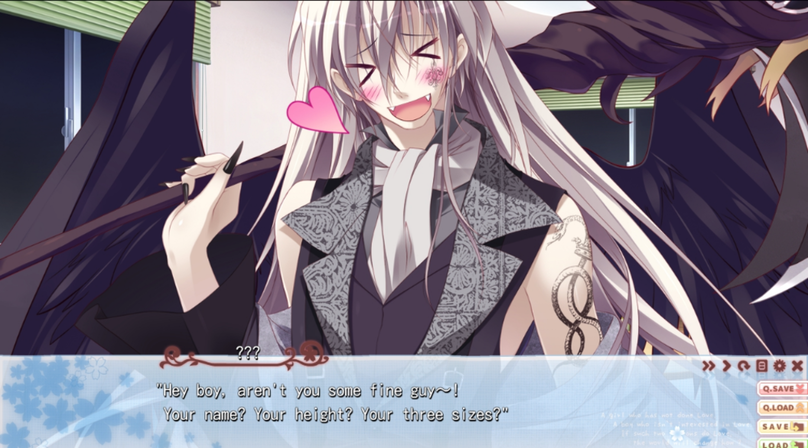
游戏的BGM还是《纯白交响曲》的风格,电子味儿有点重,但是还OK,原画和泉大妈想必不用多说,只是近年来我玩的不少游戏发现很多人都在模仿她,包括纸上的魔法使中的理央就和美樱几乎一模一样,只是和泉大妈的看起来要瘦一些。
All that griping aside, I actually think this game is pretty damn good. The plot stays tight and never drags, the romance is sweet but still feels real, the voice acting lands without ever getting hammy, and the artwork is gorgeous without cutting corners. Solid stuff. If Hanako had a route it’d probably be even better, though…
Comments are hosted on the Chinese main site. This mirror is read-only.