Review: Anbernic RG ARC-D

I’ve lost count of how many “retro handhelds” I’ve bought, but this one grabbed me hard, purely because of how it looks.

Anbernic markets it as a “fighting handheld” built for FTG, but the button layout is obviously lifted from the SEGA Saturn pad. Which means it’s not just good for fighting games — it’s better suited to SEGA MD and Saturn titles.

That’s the idea, anyway. Reality is another matter.

When this thing launched, they pulled a sneaky one and split it into two versions: the single-OS ARC-S and the dual-OS ARC-D. Generally the whole “Linux and Android dual system” thing on these handhelds is pointless, but of course this one used it as a sales gimmick. The retro colorway everyone wants is exclusive to the dual-OS model, while the single-OS one only comes in “translucent black” and “translucent white” — the colors that love to crack. And the dual-OS version costs more, so players like me end up paying extra for a dual-boot setup we’ll never use, just to get the color we want.

And in practice, this machine has way more problems than I expected.

photo_2024-02-25_00-04-25.jpg

Read More

Koibana Renai (コイバナ恋愛) Review

When I heard Asa Project’s new game Koibana Renai (コイバナ恋愛) had been slapped with the “landmine” label, I was genuinely shocked.

Sure, I think their games have been on a downward slope compared to those old meme-face classics, but there’s no way it deserves “landmine” status.

Asa Project has always made these “politically incorrect” games where the whole point is unhinged nonsense. You can force a guy into a girl’s body, you can stumble into BL endings without trying. Their audience is mostly shitposters who know exactly what to expect and have the mental fortitude for it. No way they’d get got by Asa Project’s antics and slap a “landmine” label on it.

Besides, from what I remember, their 2023 release Koibana Renai was billed more as a “youth ensemble drama” — basically boys and girls bumping into each other, and the title spells it out. コイバナ means “love talk,” so Koibana Renai feels like a big pile of lovesick brains. Tell me how that premise could possibly be a landmine. Unless the protagonist joins a youth-themed swinger club or something.

So out of curiosity I checked the game out. My first impression: yeah, it’s not good. I also get why people call it a landmine. But the reason it’s bad isn’t the landmine — it’s something else entirely.

screenshot.6.jpg

Read More

Clockworkpi Devterm

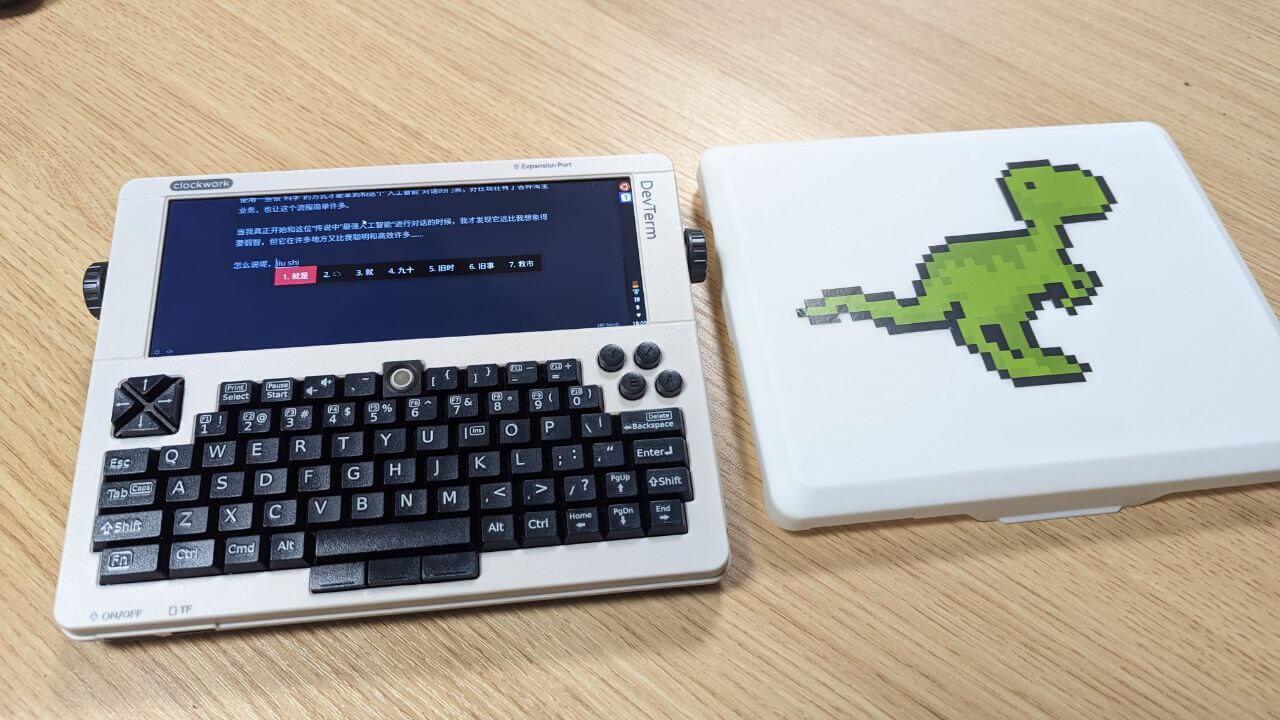
The Devterm is a portable computer from Clockworkpi, modeled on the TRS-80, the first mass-produced personal computer in history. Not a 1:1 replica of course — a shrunk-down one.

The full specs are on the official site, go look for yourself.

Here’s a quick rundown of the config I bought: the A06 high-end core, which is really an RK3399 with 4G RAM and Bluetooth/Wi-Fi built in. As far as this device goes, that’s the top spec you can get.

By the way, the core slots in as a module over a DDR2-SODIMM 200-pin interface, which means you can swap in other compatible cores yourself. I asked the official folks whether things like a Banana Pi or Orange Pi would work. They didn’t say Yes and didn’t say No — just that they only provide system compatibility for official hardware. Which I read as “it might run, but if there are driver problems, that’s your problem.”

photo_2024-02-09_16-37-06.jpg

I bought this thing on impulse. I wanted a portable text-input device, ideally one you can hold with both hands. You might say plenty of mini Windows laptops can do that, but I don’t think they’re coool. Nothing is coooler than something like the Devterm, so on a whim I dropped 1600 on a top-spec, unopened unit on Xianyu.

Read More

Advertisement

Koi ni wa Amae ga Hitsuyou desu (恋にはあまえが必要です) Review

The past few years have brought a wave of “retro.” People start missing the “old” stuff, and more and more content with a “retro” flavor gets dug out of the historical junk pile and put back into production. Keyboards with last-century styling, computers, handhelds, all sorts of odds and ends. FiiO recently put out a “cassette player,” not cheap, and chunky as hell. And yet people were falling over themselves to buy it. Even with the “retro” tax that steep, there’s still a market—at least enough of one to keep the manufacturers churning out reshelled products alive and well. Which gets me thinking about another industry soaked in the same “retro” smell: the beautiful-girl dating simulation game, commonly known as visual novel.

Anyone with a bit of history knows the earliest visual novels weren’t like today’s mainstream products. The universally acknowledged granddaddy is the Tokimeki Memorial series—I remember it also being called Jun’ai Techou, though back in the day I kept reading the pirated disc as Jun’ai Techou… anyway, not important. What matters is that Tokimeki Memorial was a deadly serious game about “simulation,” “romance,” and “raising.”

Read More

Living with Big Monster Block Bluetooth Earphones D36

A while back I was listening to a podcast from Aifou, and one line stuck with me:

“I think the most impressive thing about Lei Jun is that he can push prices down so low that nobody else can match him.”

In that context, judging by the standard of “pushing prices down,” Lei Jun really is impressive. Whether it’s Xiaomi or Redmi, they’ve definitely driven down the price of a lot of things.

But is that what “impressive” really means—driving down the price of something expensive so it sells cheap? Shouldn’t it be the opposite?

Isn’t it far more impressive to take something worthless and sell it at a very high price?

By that standard, the “Big Monster Block Bluetooth Earphones” are a very “impressive” product.

photo_2024-01-20_00-40-43.jpg

Read More

Haruka Ao no Hanayome ni (遥か碧の花嫁に) Review

There’s a classic meme about Intel releasing the 11th-gen i7-11700K, which benchmarks showed was not only worse than cheaper competitors but even worse than the previous generation—a pure reverse toothpaste squeeze. Gamers Nexus famously called it a “waste of sand.”

After playing Lump of Sugar’s so-called “new” 2023 release, I had a similar thought, and it led to the question in the title:

If selling a CPU with reverse toothpaste squeeze is a waste of sand, what does developing a completely pointless visual novel count as?

screenshot.6.jpg

Read More

2023 Splurge Log

2023 was a fairly significant year for me, and a busier one. The price of being busy is that I messed around with a lot of stuff but couldn’t be bothered to write up impressions. Half the time I’d tinker with something, list it on eBay, and then feel even less like writing. You can call me busy, you can call me lazy, or I can just say the thing had no highlights and wasn’t worth writing about. But it’s the end of the year, and I don’t want this year’s business spilling into the next. So here’s a summary looking back at what I messed with this year that’s worth mentioning, with some blunt takes and a recommendation ranking thrown in. These are all short notes, no screenshots. Anything that deserves a deeper writeup I’ll do separately.

photo_2023-12-31_23-46-24.jpg

Read More

Mashiro Iro Symphony REMAKE FHD SANA EDITION (ましろ色シンフォニー REMAKE FHD SANA EDITION) Review

I vaguely remember it — a night about eleven years ago, back when I was still a pure, innocent little 2D virgin.

I’d followed the Mashiroiro Symphony anime all the way to the end, and like most of the fat otaku who watched it back then, the redhead’s crying at the end was where it all began.

And at the end of the anime, they told you a PSP version with an added route for the redhead was coming out. I had a PSP at the time, but my Japanese wasn’t good enough, so I did what everyone else does — waited for a fan translation.

That wait turned into two years.

screenshot.6.png

Read More

RG35xx and Miyoo Mini Plus: First Thoughts

In recent years the term “open-source handheld” has basically drifted away from what it originally meant.

Originally “open-source handheld” referred specifically to retro handhelds running open-source systems. Some were commercial products flashed with third-party firmware, like the early Subor RG97; others were open by design from the start, like the later Odroid Game series.

But what comes to mind now when someone says “open-source handheld”? Generic molds, RK3566 SoCs, and a pile of messy emulators. Lately Android comes standard.

Never mind whether the shell infringes on anyone’s design—the SoC’s own attitude toward the open-source community is questionable. That’s why overseas these products were never called “Opensource Handheld” but “Retro Handheld.”

A handheld for playing retro games, so retro handheld. Makes sense.

Today I’m talking about two retro handhelds you could call “closed-source handhelds”: the RG35XX from Anbernic (Zhou-ge), and the Miyoo Mini Plus from Miyoo, Zhou-ge’s nemesis.

Read More

Advertisement

Sakura no Toki (サクラノ刻) Review

Thinking back, Sakura no Uta (サクラノ詩) was eight years ago now.

I rated it pretty highly at the time, and it resonated with me on a personal level given some of my own experiences.

It genuinely taught me a lot too, especially about the relationship between “mathematics” and “art” — the correspondence between the golden ratio and the Fibonacci sequence had me half-convinced that a “Creator” and “God” might actually exist, and made me instantly understand why so many scientists end up turning to mysticism.

Because there’s just too much in this world that’s strange, mysterious, and completely unexplained.

All that to say, I got a lot out of Sakura no Uta, and even purely as narrative it’s plenty gripping — honestly it’s that gripping story that kept me reading, and along the way I picked up all sorts of interesting trivia.

I figured the story was over, since the ending really didn’t leave any obvious room for a sequel. Then I heard about Sakura no Toki (サクラノ刻).

There’s a sequel? What would it even be about? I genuinely had no idea. The female students who barely registered in the original main plot? Or forcing a route onto Ms. Ai, who was already perfectly complete as she was? The protagonist’s relationship with her was lovely precisely because it wasn’t family but might as well have been — were they really going to shoehorn a romance in just so she’d be “routeable”?

No way, right? There’s no need to be that tacky… doing that would drag down the whole game’s prestige and even wreck the protagonist’s character. I already thought him getting with Misono Rin was a stretch — that was already a concession to “R18 game sales” — no need to go that far, surely?

And then with the release of Totono no Sora Remake (终の空 Remake), I became even more confident about Sakura no Toki. I figured it absolutely wouldn’t be some unnecessary sequel milking the name, nor a rushed product made just to pander to players by forcing a route onto some character.

Well, Sakura no Toki came out anyway, and you can probably guess the rest.

I was wrong. Spectacularly wrong.

Screenshot (64).png

Read More