Kobe Renai Monogatari (神戸恋愛物語) Review

This is a text-based romance adventure game that first shipped in 1989 on the Japanese NEC PC-8801, titled Kobe Ren’ai Monogatari (神戸恋愛物語). Anyway, one thing led to another and I decided to give it a shot. The game comes on seven floppy disks, though I think I only used six to finish it — maybe the last one is a user disk? No idea.

It isn’t long, an hour and change, and along the way the story keeps prodding you to swap in the next disk. The whole thing weighs 2MB, which in 1989 was squarely AAA-tier capacity. Bear in mind the average computer back then had a 20–30MB hard drive, so 2MB was like eating 100GB out of a 1TB drive today. And an hour-plus of playtime doesn’t look great next to that capacity — it’s on the short side.

Controls are simple: observe, talk, listen, act, leave. Those options bounce around different scenes; move and talk get used the most. Basically you move, talk, move, talk again. Looks like a lot of choices, but it’s a straight line — talk through this scene, move to the next, repeat until the credits.

Screenshot From 2026-07-16 19-35-06.png

Which brings me to the story, and it’s a bit… unexpected.

Read More

Review: Sharp Dtab D-41A

I think I bought this tablet around November 2024, from everyone’s favorite OK shop. The reason was simple: I wanted a tablet, and the only goal was watching videos. Ideally stock Android, able to install GMS, and not a Chinese brand…

The price at OK at the time was hard to refuse — a bit over 300, under 400, and the condition was decent, so I grabbed it.

photo_2026-07-16_23-49-40.jpg

Read More

A Few Days with Gal Touch

I’ve been playing visual novels again lately, but I got fed up with my old device and went back to the Windows tablet camp. This time it’s a Lenovo 10-inch tablet with an N200 — performance and keyboard are nothing to write home about, but the screen is decent and the battery holds up. Personally I’d say it’s a bit better than the Surface Go 4. I’ll save the tablet talk for another time; today it’s about the software side.

Going back to a Windows tablet for visual novels, my old workflow felt a bit off. So I sorted out what I actually need when playing visual novels:

  1. Fast Ctrl-to-skip, and easy access to the game’s backlog
  2. Toggle between fullscreen and windowed
  3. Easy one-tap screenshots
  4. Show current power draw so I know how much battery time is left

With the requirements clear, I outsourced it — to AI, for free — and called the result Gal Touch.

photo_2026-07-15_11-32-55.jpg

Read More

Advertisement

Relirium -Iseki to Deai to Bouken to- Review

Back in January, when Whirlpool announced their new game, they also announced it would be their last. After it shipped, they’d play a small live show, then dissolve for good.

Honestly, Whirlpool disbanding didn’t surprise me. What surprised me was how sudden it was. I thought their reputation had just started to turn around. Their smaller titles were selling decently on Steam too. Why the hell would they suddenly drop dead?

They later explained it on their blog. It wasn’t that they’d run out of money. The main reason was that they’d run out of ideas. They’d made all the games they wanted to make, pitched all the projects they wanted to pitch. If they kept going, it’d just be more crap, so they figured they might as well disband.

It’s kind of like Qiong Yao killing herself before things got ugly. Quit while your name still means something, rather than stick around until your brand is a landmine and you’re doing a humiliating bankruptcy liquidation.

Anyway. As a final work, how does Relirium -レリリウム- 遺跡と出逢いと冒険と actually hold up?

photo_2026-07-12_00-58-54 (2).jpg

Read More

Yosuga no Sora (ヨスガノソラ) Review

There’s something I’ve never actually admitted: I have never played Yosuga no Sora. I haven’t even finished the anime.

Like most people, I only watched the spiciest episode. It was around 2010, and the final episode was sitting right on the Bilibili anime front page, so I clicked it. No censorship glow or anything. It got boring fast, obviously — the fall season that year was stacked. There was Oreimo, which needs no introduction, and The World God Only Knows, which stuck with me for a long time. Yosuga no Sora felt like just another borderline show.

Later, as I got deeper into otaku circles, I roughly understood what Yosuga no Sora was — a story about twin siblings becoming lovers. I even saved a few wallpapers of Sora. But I still never touched the game, never finished the anime.

There are reasons. The plot is already common knowledge. Is there any point in going back to the game and anime? Isn’t it just the poster child for siscon games?

So I stayed in “cloud player” mode, watching the Yosuga no Sora IP get meme’d year after year, milked year after year, until it became a cash cow that guarantees steady revenue for the company — even though the game itself is ancient.

Which made me a little curious. I mean, is there any chance this game isn’t as simple as I thought? So I decided to play it and shed the “cloud player” label.

Read More

Impressions: Saturn Controller

Back in the handheld emulator scene, a lot of people were obsessed with the idea of a “fighting handheld.” Mostly old-timers grinding KOF 97, pining for a handheld with good feel that could handle fighting games, or side-scrolling beat ’em ups and the like.

And of course the god of the bootleg handheld world, Zhou Ge, answered their prayers with the Anbernic RG-Arc, a machine that’s blatantly modeled on the Saturn, complete with the standard six-button layout and that familiar disc-style D-pad.

But once the thing came out, a bunch of old-timers weren’t happy, saying the design fell way short of the original Saturn, especially the D-pad feel, which was off by more than a little. They all insisted that only the original Saturn pad had that flavor, that perfect balance of firmness and give, that silky-smooth quarter-circle execution…

Read More

ROG Ally X: First Thoughts

Back in May last year, I noticed the ROG Ally X handheld was not only in stock on JD.com, but the price was back to normal, and it even qualified for the national subsidy. Basically, a machine that originally cost over 6000 RMB ended up discounted by a little over 1000, so I got it for under 5000. The reason JD.com gives you is the “national subsidy,” but in reality you don’t need to bind any qualification for this subsidy—you just need your delivery address to be in Shanghai. A victory for the “Shanghai lords,” you could say.

Naturally, I asked a fellow townsman bigshot in Shanghai to receive and buy it for me, and successfully got my hands on this handheld. A lot of people probably want to know: I’m a SteamDeck shill, so why did I buy ASUS’s handheld? How should you choose between it and the SteamDeck? I think I can explain it briefly with these points:

  1. It’s a Windows handheld, so it can play Windows-exclusive games (visual novels)

  2. It’s the only Windows handheld I know of that’s continuously optimizing power efficiency

  3. It’s the best Windows handheld I know of when it comes to self-made power control software

  4. At the time (2025), it had the largest battery capacity among Windows handhelds

Some might bring up the ROG Ally + big battery mod, which has basically the same performance, but the biggest difference with the ROG Ally X is its 24GB of native RAM. The change that big memory brings is that you can allocate a large amount of VRAM to games, especially those poorly optimized ones that all need lots of VRAM. And from my observation, the root cause of stuttering when the SteamDeck runs those badly optimized games is often insufficient memory, and the ROG Ally X can clearly improve that.

Read More

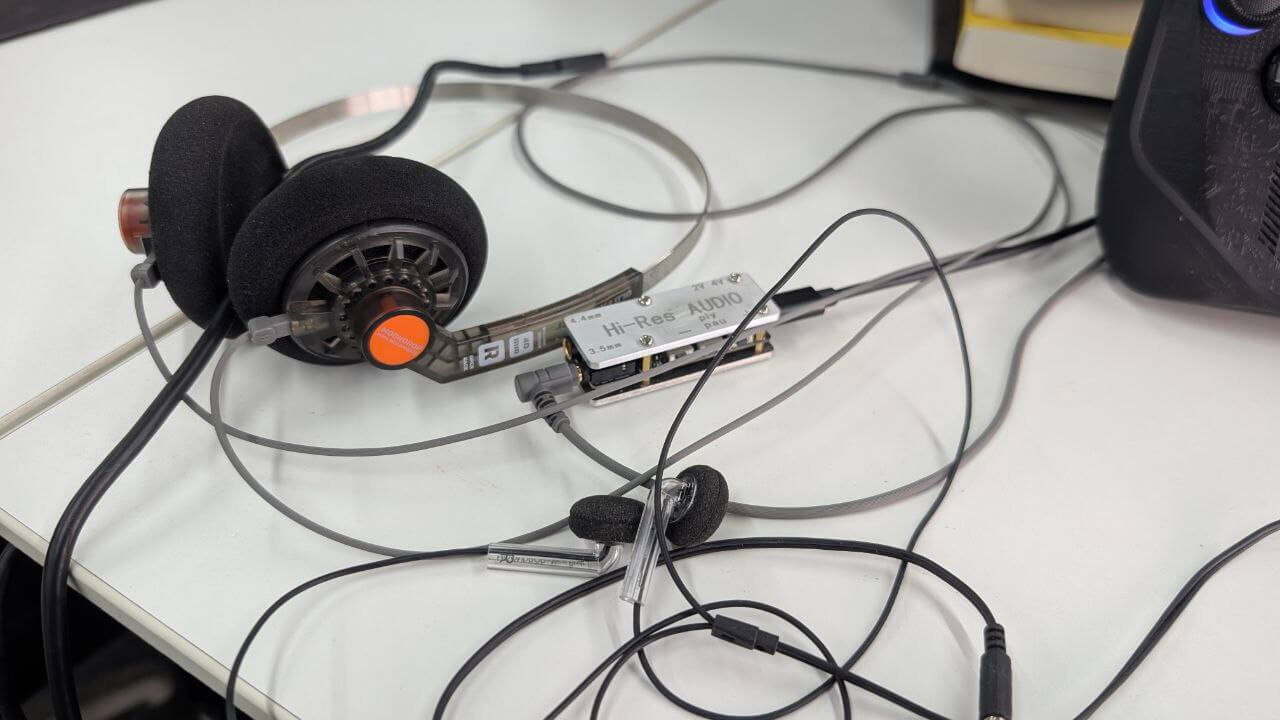
Impressions: Moondrop Nice Buds & Old Fashioned

I’ve never really had anything against Moondrop as a brand. I bought a pair of their ~300 RMB earphones a while back and they were fine — build quality and sound both held up. Their “anime marketing” is just a product-promotion路线, and it’s clearly worked. With the audio market getting more and more cutthroat, you have to differentiate to survive, even if that means leaning into a “trendy” style.

So you see all these streetwear brands charging a premium for design and brand recognition. Moondrop charging a premium by rubbing up against ACG culture seems fine to me too — and their low-end stuff doesn’t even carry much of a premium. Instead, while keeping basic quality intact, they give you some “fashion” elements. At least they’re the best-looking option in the budget tier, right? You wear earphones out in public, so beyond sound quality, treating them as an accessory is a perfectly good approach. As for the industry “veterans” who trash Moondrop’s high-end products — in this mystical audiophile domain, high-end products are basically an IQ-tax genre anyway. Once you’re in IQ-tax territory, buying a Moondrop at least looks better on you than a HiFiMan.

Recently Moondrop released two products I quite like: the Nice Buds and the Old Fashioned. Both are budget-focused with a retro flavor — one’s an earbud, one’s an over-ear.

photo_2026-02-13_16-37-12.jpg

Read More

Advertisement

ToHeart Review

Honestly, I’ve always held ToHeart in something close to sacred regard.

Sounds like bullshit, but that’s how it is. When I was a kid I played it by pure chance — no idea which version, probably on a PS emulator or something, some pirated disc anyway. It blew my mind, mostly because I couldn’t read a single word and just clicked around at random. Around the same time my cousin was playing Princess Maker and Uncharted Waters, and I remember some magazine — Computer Fan or Popular Software, can’t recall which — running a piece where someone gushed about Sakura Wars, said you had to play it in this lifetime or you’d regret it forever.

So I came to see these games — Japanese, text-and-dialogue-driven, choices tied to a calendar — as something lofty and sacred.

That’s the impression ToHeart left on me. Later, after I got into anime, I kept spotting homages to it everywhere, which pretty much cemented its historical status. Some people even say it inspired all the stuff that came after, blah blah blah.

So when the ToHeart remake was announced, I was paying close attention. The promo PV got me hyped — full 3D production, which surely meant a next-gen experience, fundamentally different from those so-called traditional visual novel remakes that are just AI upscales.

Of course, Japanese game pricing. When it launched I couldn’t afford it and had no time to play anyway. Then the winter sale hit, I grabbed it, and after about half a month of playing I painstakingly cleared three routes (not counting the bro). And I was utterly converted…

Insanely good. You’d need a brain clot and a low IQ to screw up a remake this badly.

3.jpg

Read More