Switch: The Liangzhi Silicone Case
Someone gave me this silicone case. I wouldn’t have bought one myself — for the Switch I figure a pouch is plenty.
Well, they gave it to me, so I tried it out…

Someone gave me this silicone case. I wouldn’t have bought one myself — for the Switch I figure a pouch is plenty.
Well, they gave it to me, so I tried it out…
I’ve always made sweet cookies, so this time I figured I’d try a savory one.
Finished product first:

I’ve been using Windows 10 a lot lately. Personally I’m looking forward to Red Stone 4 and hope it ships soon.
Why Windows 10? Because Linux still doesn’t handle fractional scaling well, and Windows 10 does it best. The one with the best shot at supporting it is obviously GNOME Shell.
But using GNOME Shell feels like this:
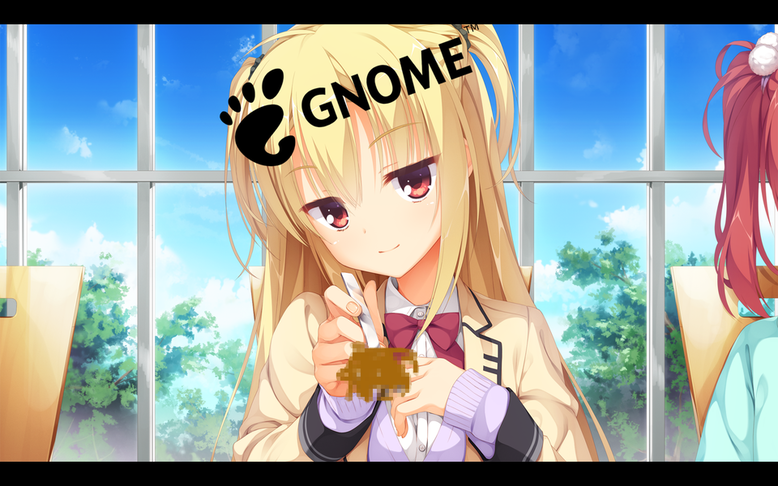
Recently I ran into a permission problem on Ubuntu. It shows up when downloading stuff like flash or mscorefronts. I’d been ignoring it all this time, but today I decided ignoring it isn’t great.
Files can’t be accessed by user ‘_apt’, and the permission can’t be dropped for downloading
The fix is simple…

Black Domain on Android is an app that kills rogue apps, aiming for “an Android experience just like iOS.” That’s a bit different from Greenify — Greenify feels more academic, while Black Domain is more practical.
I paid for both. In the end I went with Black Domain.
Black Domain works without root too. You just have to turn on USB debugging and type a command to start one of its processes. Calling it a hassle is fair, and calling it convenient is fair — basically, every time your phone reboots, you have to find a computer to activate it…
So the author of Black Domain had an idea: make a “Black Domain Activator.” It’s a collaboration with some gamepad adapter, but using it is fine anyway, and it’s cheap.

If you watch a lot of anime or play galge, you’re probably familiar with a certain setup. In Japanese otaku-oriented fiction, the most common one is the “harem.”
This “harem” is a bit different from the Qing dynasty harem dramas we’re used to. Even if it’s somewhat similar to something like The Deer and the Cauldron, it’s still not quite the same.
Japanese harems mostly consist of “the male lead maintaining ambiguous relationships with multiple women for a long time but never fucking confessing.” Because Japan is monogamous, you see—if you confess, that means the other women are done for, game over, loser dogs, and the harem loses its meaning.
This “harem” thing thrives on that borderline-level ambiguity. You can be naked and hugging all sorts of girls, you can see their entire bodies, you can kiss, you can grab tits, you can even touch pussy, but as long as you don’t stick it in, you and she are just ambiguous, the other women still have a chance, and your harem can continue. So the actual fucking is generally the bottom line. Most harem works never cross that line—unless they’re heading for the ending.
However, “harem” in the context of a visual novel is a different picture entirely… Because visual novels have no bottom line, harems split into “true harem” and “fake harem.” “True harem” is exactly what it sounds like—ハーレム—the male lead does 3P, 4P, 5678P… all sorts of indescribable things. “Fake harem” is still the manga/anime routine: all sorts of ambiguity, all the heroines like the protagonist, but since it’s a visual novel you’ll definitely hit a home run and it won’t drag on without an ending like some dumbass manga or light novel.
Most harem setups go like this:
Ahuhu is an unbelievably ordinary high schooler. At home he has a sister who’s an unbelievably brocon and hates squid, next door lives a childhood friend named Xiaozhu who walks to school with him every day, the student council president at school is a sharp-tongued girl who deliberately picks fights with him every day, and meanwhile Ahuhu has a crush on some girl in the school library—a recent transfer student he ran into by chance on the train one time.
Ahuhu keeps saying he has no luck with love, but the story ends with his sister wanting to marry him, Xiaozhu insisting she’s just a childhood friend while actually masturbating to him every day, the student council president being a tsundere who’s crazy about him and only picks fights to talk to him more, and the library girl actually liking him too but unable to say it no matter what, keeping it bottled up inside…
So Ahuhu, while humbly calling himself a loser, simultaneously juggles all these beautiful girls like some romance-blind KY idiot, until some event triggers a choice and a confession…
Familiar? Clichéd? I can’t say for manga and light novels, but at least most visual novels follow a similar setup…
Honestly, this setup has plenty of holes, especially the protagonist claiming he has zero luck with women:
“You motherfucker Ahuhu, your luck with women is off the charts!”
You get used to complaining about this stuff. Some games try to break out of the framework, but they always roll back in the end… After all, if you want to write multiple heroines, this is the only way… what else can you do…
Yeah, what else can you do? Well, a company called Hook gave us a different answer, showing us what a harem looks like when it doesn’t follow the formula…
Kikuzakura is a beautiful girl, with pretty pink hair, fair skin, and a sweet smile.
She doesn’t remember her original surname. She doesn’t even know who her parents are. For as long as she can remember she’s lived with her grandmother.
“Grandmother” is only the woman who took her in, not real blood relation. Kikuzakura has asked her many times:
“Where are my mom and dad?”
Grandma always smiles, strokes Kikuzakura’s head, and says slowly:
“You’re still young. When you’ve grown up, I’ll tell you.”
Time flies. In the blink of an eye Kikuzakura is an adult, eighteen years old.
On her eighteenth birthday, after they finish the cake, Grandma gives her a present. The little box is heavy, and she can’t tell what’s inside.
Kikuzakura wants to tear it open right away, but Grandma stops her.
“After the cake, tonight, in your room. Look at it slowly, by yourself.”
Grandma’s expression is full of a kind of helplessness… as if there’s something she can’t say.
Kikuzakura nods…
…………
An autumn night, cool breeze blowing. Kikuzakura sits at the desk by the window and opens this Pandora’s box.
Inside is a notebook… the paper between the layers has already yellowed a little, but the cover is thick enough that the contents should still be fine.
She lifts the first page. Tucked inside is a photograph: a pink-haired woman holding a baby, smiling at the camera.
Kikuzakura understands. There’s news of her parents in here, and the person in the photo is her mother.
She keeps flipping. It’s a diary… a story from the past, unfolding before Kikuzakura page by page.

A few days ago I had dinner with some big shot from Beijing, and we got to talking about whether GNOME Shell is shit or not these days…
We arrived at the same conclusion: GNOME Shell is a piece of shit.
And it’s not just that “GNOME Shell itself” is shit — it’s more that “the whole pack of shitty GNOME Shell developers” is shit.

GNOME Shell has been talking about supporting fractional scaling since last year. The feature was already mostly done last year, with only final fixes left. It was supposed to ship in GNOME Shell 3.26, but they ran out of time and it slipped to GNOME Shell 3.28. The GNOME devs even wrote a blog post bragging about how amazing GNOME is, how it has every feature, fractional scaling included.
Yet a year later, with GNOME Shell 3.28 Beta about to be released, the fractional scaling feature is still nowhere to be seen.
Is nobody working on it? Of course not!
I’d never even heard of “lazy hot pot” until recently. I saw a Hong Kong YouTuber called Slime try one on YouTube, and it got me itching to give it a shot.
I knew the principle was basically the same as some military ration I’d had before, but curiosity still won and I bought one to check it out.

A recent batch of Unity and Compiz updates landed on Ubuntu 16.04, and it broke my fractional scaling.
Someone already filed a bug, but nobody seems to give a shit.
So what do you do? Roll back, obviously. Except rolling back Unity isn’t that simple — too many dependencies, plus core components like Compiz. If you’re going to roll back, you might as well go big.