Hajilove -making*lovers- (ハジラブ -making*lovers-) Review

Last year SMEE put out a game with a seriously baffling title. I mean the title itself is baffling.

Hajilove -making*lovers-

See, the actual title is Hajilove—first love—while the subtitle is borrowed from another well-known SMEE work, Making Lovers. Making lovers… as in making girlfriends, I guess. Why call it baffling? Because at a glance it looks like a Making Lovers sequel when it isn’t one at all.

The reason for the naming is simple: riding the coattails. They want you to think this new title—which shares neither artist nor writer nor production team with Making Lovers—is the spiritual successor to the Making Lovers series. Buy it, and the sales go up.

So why not just make an actual Making Lovers sequel? Here’s the kicker: Hajilove -makinglovers-* is really SMEE’s first attempt at the nukige space. SMEE has always stuck to a vaguely societal “pure love” lane, mostly matchmaking games, and nobody ever expected to fap to a SMEE title. So their “practicality” push this time is shy and embarrassed—still insisting over and over that it’s “pure love,” even after hiring several nukige artists…

The reception to Hajilove turned out better than expected. A lot of old fans said they weren’t comfortable with the sudden nukige pivot, but the body doesn’t lie, and sales don’t either.

With SMEE’s successful borrowing, its sister brand HOOK naturally had to take the same step, and so we got Secret Love (Kari).

photo_2024-11-22_11-14-47.jpg

Read More

Impressions: The KOSS Demo Headphones

I spotted something weird on eBay recently: KOSS demo headphones.

They were pretty cheap, and even after a slight price bump they’re still not expensive. I’ll admit the looks got me, and the listing said these use the same driver as the KOSS PP, with the same performance, and that KOSS used them as demo units.

Most of all, those orange foam pads are genuinely nice-looking.

So I got impulsive and grabbed a pair to see how they do.

photo_2024-11-19_00-46-27 (2).jpg

Read More

Hajimeru Sekai no Risouron (はじめるセカイの理想論) Review

Everyone goes through a chuuni phase. When I was young I loved collecting “really deep, philosophical” lines, treated them as gospel, and quoted them constantly to look like I had some kind of inner depth.

Stuff like “humans are all selfish,” “humans are just animals driven by primal urges,” “society is dark,” “the world is one big conspiracy”… and so on.

Guess everyone’s got their own personal Black Myth going on.

Say that stuff now and it just feels embarrassing. It’s not that those lines are wrong—a lot of them are straight-up facts—but they’re all “correct nonsense.”

“Humans are ugly, selfish, profit-driven…” (sounds even better in Japanese, some 人類とは…… type shit)

Yeah, and? No shit. Does repeating it let you exploit these “human weaknesses” to make money? Or do you have some way to free humans from those “weaknesses”? If anything, the guy who keeps chanting about them is himself living inside them 24/7.

Once you’re an adult and you’ve seen enough, most of this stops surprising you. What you care about is how to make yourself feel good, in a more practical sense.

If something pisses you off, either change it, accept it, or put up with it. Anything else is just noise.

That’s reality, sure, but in games and films this kind of material still sells. In reality we’re powerless, but in a virtual world we can fantasize about saving the world. So even in the visual novel space, the “become a creator god” premise is popular—parallel worlds popping up everywhere, giving you that high-tier-being experience of watching the seas turn to mulberry fields, a thousand years in a glance.

Which brings us to Uzumaki-sha’s Hajimeru Sekai no Risouron (はじめるセカイの理想論).

2024-10-05T17:14:10.png

Read More

Advertisement

A Very Painful but Meaningful Server Deployment

Foreword: Around the end of last year, I got handed a weird task: deploy a server with a specific function, using an old decommissioned machine from work. What I didn’t expect was that this one task would drag on for half a year, on and off. It wasn’t urgent—more of a “nice to have, whatever if not” situation—so it didn’t really affect my actual job. But the deployment hit a ton of potholes, ran into what looked like hardware failure, got some unexpected “expert guidance,” and the solution went through more twists than a soap opera. I wanted to give up multiple times, but for some reason I kept going. I don’t even know why. So I figured I’d write it down—maybe it’ll help someone with a similar experience.

Let me get the disclaimers out of the way first, so the smartasses don’t come jumping in:

  1. Don’t ask me if this kind of server is even worth it.
  2. Don’t say “just throw more money at XXX and be done with it.”
  3. Don’t say “stop messing with e-waste.”
  4. Don’t say “this setup isn’t secure.”

I know all this better than you. Just treat it as me having fun.

Screenshot From 2024-09-26 17-24-22.png

Read More

Love Pical Poppy (ラブピカルポッピー) Review

I actually played this game a while ago — I even wrote a commercial piece on it — but I never got around to blogging about it, mostly because I forgot.

I’ve forgotten almost the entire plot too. If I hadn’t been sorting through files today, I’d have pretty much erased the fact that I ever played it.

So what kind of game is this? According to SMEE, it’s not just any game — it’s a commemorative game. Commemorating what, exactly?

First, it’s SMEE’s 15th anniversary title. Second, it commemorates SMEE’s cumulative sales hitting 150,000 across all its games.

The first time I saw those two “commemorations,” I nearly lost it. What kind of commemoration is this? Since when does 15 years even warrant one? And it’s not even a real “15th anniversary” — look closer and it turns out the project was conceived during the 15th anniversary… holy shit, that counts too. And this is the first time I’ve ever seen “cumulative sales” used as a reason to commemorate something. It reads like someone forcing out content when they’ve got nothing left.

photo_2024-09-24_23-48-23.jpg

Read More

A Few Days with Remarkable

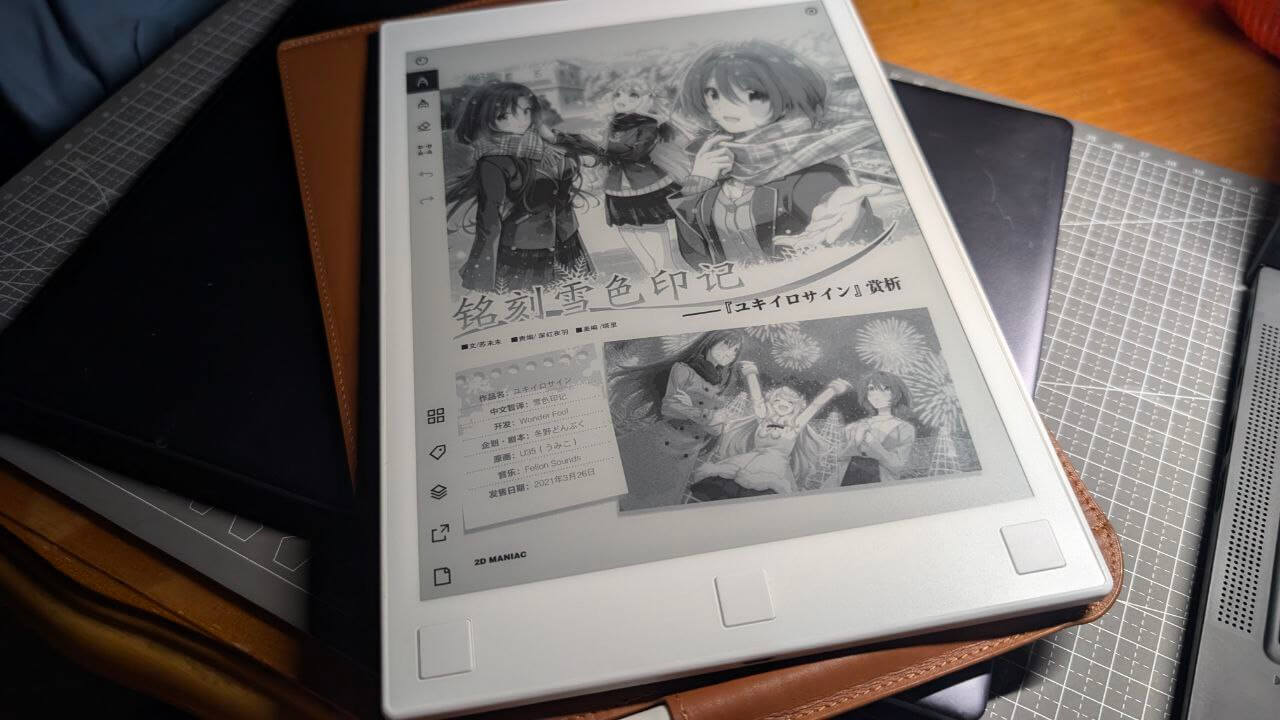
Last year, I think, Qingzhou Xiaoxiong—the online seller most respectful of electronic waste—listed a batch of e-ink devices: the first-generation Remarkable, at a very lovely price, probably under 600 yuan, brand new. I got excited and grabbed one, and I’ve been using it on and off as a reading and e-paper device ever since. Here are some quick thoughts.

photo_2024-08-20_22-50-54.jpg

Read More

Review: GPD Win Mini

I’ve been playing fewer visual novels lately, but that doesn’t mean I’ve left the scene — I’ve just played a bunch of stuff and haven’t felt like writing about any of it. And since that last post, I’ve upgraded my “gal machine” too: swapped it out for a GPD Win Mini, which I’ve been using ever since.

This little thing is honestly better than I expected. As a “gal game player,” I can’t find anything more suitable right now.

I’ve said before that if I ever bought another GPD product I’d eat shit, but this little guy has somehow become GPD’s best product to date, and the “gal machine” I’d recommend most. So, well — time to eat.

photo_2024-07-24_17-58-28.jpg

Read More

Boku no Kanojo wa Ningyo Hime!? (僕の彼女は人魚姫!?) Review

Years ago — don’t ask me where, probably the Google Play Store — I came across a game called Boku no Kanojo wa Ningyo Hime!? (My Girlfriend Is a Mermaid Princess!?). It was a mobile game, but it looked like a visual novel. I didn’t have time for it back then, so it went on the pile.

Later I found out it had actually been ported to PC and put up on Steam, complete with a bunch of language options. So at some point it ended up in my Steam library…

Well, I have to admit it: I’ve been “cleaning out” the visual novels in my Steam library lately, so this Mermaid Princess became the next target.

I did finish it, and picked up all the achievements along the way. But when it comes to actually reviewing it, I find it hard to say anything.

71qNTJa+ZDS.jpg

Read More

Once` Review

There’s a phenomenon in the Chinese hip-hop scene: some rappers copy a foreign artist’s style, flow, cadence, even melodies and beats and vocal delivery, wholesale. All they do is sing in Chinese. People used to call them “localization tailors”; these days there’s a more precise term — “clones.”

The word is blunt and easy to get. It describes exactly what’s happening: full-on imitation of someone else, to the point of copying and cloning. If the language were the same you’d just call it plagiarism. But it’s not quite plagiarism — it’s arguably worse than plagiarism. Most clones copy only the flashy surface, never the substance. The result is clumsy and ridiculous and doesn’t bring anything new, whereas plagiarism at least lets you appreciate the original by proxy.

This isn’t limited to hip-hop. Every scene has them. Even the visual novel scene — a sunset industry that’s been pronounced dead for years — has its clones, especially in the “Chinese-made” corner we’re all familiar with. Honestly, most Chinese visual novels are clones. The story is set in Chinese daily life, but nothing about it feels Chinese; the phrasing and every joke come straight from Japan. This is the “can’t talk like a normal person” anime-speak I’ve been complaining about for years. It’s deeply infected most Chinese gacha games too, making a whole bunch of Chinese voice actors sound painfully awkward, and then everyone blames the VAs’ skills and “mother tongue shame,” plus the purified fanbase that forms once these VAs get idolized and turned into streamers, all rushing to defend them. Peak postmodern structural carnival.

screenshot.235.jpg

Read More

Advertisement

Houniao (候鸟) Review

I don’t know when I bought a Chinese-made visual novel (for lack of a better word) called Migratory Bird on Steam. I strongly suspect I meant to buy Qingxiang and misclicked, but whatever — it’s bought, no refunds, might as well take a look.

From top to bottom, the production values on this thing are relatively “serious.” The whole work gives off this dead-earnest vibe. That’s not a dig, and it’s not a joke — I mean it in a mostly positive way.

The story’s theme is the one we always see when former high schoolers look back on the Gaokao years: the Gaokao sucks, but youth is forever. It follows an utterly unremarkable male student who loses his sense of direction, meets the top-of-the-class heroine, finds a reason to try, grinds through high school, watches his grades climb, and promises her they’ll get into the same school. He fails the first Gaokao, but resolves to repeat the year for her sake and his own future — and it works out.

screenshot.217.jpg

Read More